
April 25, 2014
Attain Capital
Like
I
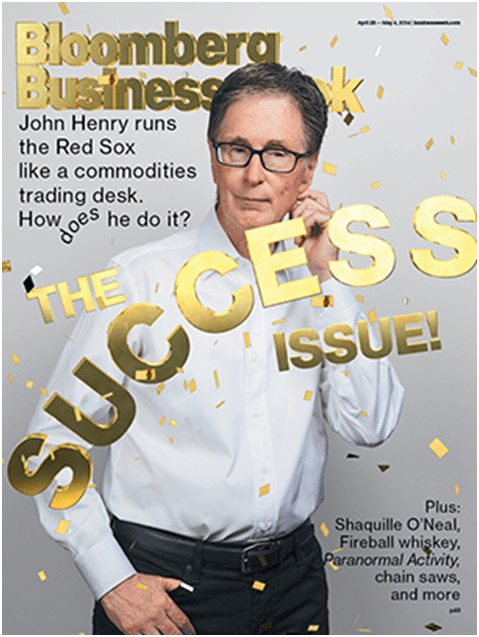
f you haven’t heard yet… Billionaire Boston Red Sox owner John Henry got his start in the commodities industry, and more specifically – the niche hedge fund segment known as managed futures. He’s never been shy about a magazine cover, or cameo in MoneyBall, and despite his being out of the ‘commodities’ business for a while now, he’s on a recent cover of Bloomberg Business once again linking the Red Sox with commodities.
We’re not sure why he’s picking at his ear… or how in the world he got journalist Joushua Green to do a piece on him (maybe something to do with Green being an “infrequent columnist” for the Boston Globe, which Henry just so happened to buy last year). Or why there isn’t much mention of the fact he closed down his commodities fund in 2012. But whatever the reasons, the article shed some light on the early history of what has become an industry with hundreds of billions under management:
“In the late 1970s, futures speculating was the arcane province of a small group of short-term traders who operated mainly on instinct. Henry’s algorithms were built to identify long-term trades based on historical price patterns. This put him in the vanguard of an even smaller group of traders who pursued an investment strategy called trend following. Trend following developed in the ’60s and ’70s out of the efforts of Richard Donchian, who founded the first managed futures fund. Donchian thought price movements of stocks and commodities were often too optimistic or pessimistic because they reflected the emotions of the people trading them. Trend followers sought to profit from this insight, often using a runup in price as an entry signal: They’d buy when other traders got nervous and started bailing out, then wait for a breakout.”
The article goes on to surmise that it was Henry’s background in the systematic trading of commodities that put him in the perfect position to thrive in the baseball crazed city.
“One of the things that was interesting about his model as a commodities trader was that it protected you from emotion, so you would make decisions that made sense. Often in sports, you become attached to something emotionally.”
In a nutshell: The Red Sox got on base more often than any other team in baseball, saw a ton of pitches, rarely swung, and crushed the balls they did swing at, especially fastballs. Napoli was all these tendencies rolled into one. The team’s defensive efficiency also improved, thanks particularly to Victorino and Drew. All of this came together in the World Series, when the Red Sox wore down St. Louis Cardinals pitchers, led by Ortiz, who hit .688 and won Most Valuable Player honors. Lucchino recalls with a laugh. “He couldn’t understand it. But it’s a function of plate discipline. You force guys to throw curveballs, you take a lot of pitches, they fall behind in the count, then they have to throw you fastballs.”
Baseball terms may just be the best way to describe managed futures and global macro type investments which are ‘long volatility’ plays. Managed futures is about getting on base (being in many markets at the same time), waiting for the pitches (living through the drawdowns), until Ortiz hits the grand slam (capture big outlier moves).
Now if only the Cubs and Theo Epstein could follow suit.
Disclaimer
The performance data displayed herein is compiled from various sources, including BarclayHedge, and reports directly from the advisors. These performance figures should not be relied on independent of the individual advisor's disclosure document, which has important information regarding the method of calculation used, whether or not the performance includes proprietary results, and other important footnotes on the advisor's track record.
The programs listed here are a sub-set of the full list of programs able to be accessed by subscribing to the database and reflect programs we currently work with and/or are more familiar with.
Benchmark index performance is for the constituents of that index only, and does not represent the entire universe of possible investments within that asset class. And further, that there can be limitations and biases to indices such as survivorship, self reporting, and instant history. Individuals cannot invest in the index itself, and actual rates of return may be significantly different and more volatile than those of the index.
Managed futures accounts can subject to substantial charges for management and advisory fees. The numbers within this website include all such fees, but it may be necessary for those accounts that are subject to these charges to make substantial trading profits in the future to avoid depletion or exhaustion of their assets.
Investors interested in investing with a managed futures program (excepting those programs which are offered exclusively to qualified eligible persons as that term is defined by CFTC regulation 4.7) will be required to receive and sign off on a disclosure document in compliance with certain CFT rules The disclosure documents contains a complete description of the principal risk factors and each fee to be charged to your account by the CTA, as well as the composite performance of accounts under the CTA's management over at least the most recent five years. Investor interested in investing in any of the programs on this website are urged to carefully read these disclosure documents, including, but not limited to the performance information, before investing in any such programs.
Those investors who are qualified eligible persons as that term is defined by CFTC regulation 4.7 and interested in investing in a program exempt from having to provide a disclosure document and considered by the regulations to be sophisticated enough to understand the risks and be able to interpret the accuracy and completeness of any performance information on their own.
RCM receives a portion of the commodity brokerage commissions you pay in connection with your futures trading and/or a portion of the interest income (if any) earned on an account's assets. The listed manager may also pay RCM a portion of the fees they receive from accounts introduced to them by RCM.
Limitations on RCM Quintile + Star Rankings
The Quintile Rankings and RCM Star Rankings shown here are provided for informational purposes only. RCM does not guarantee the accuracy, timeliness or completeness of this information. The ranking methodology is proprietary and the results have not been audited or verified by an independent third party. Some CTAs may employ trading programs or strategies that are riskier than others. CTAs may manage customer accounts differently than their model results shown or make different trades in actual customer accounts versus their own accounts. Different CTAs are subject to different market conditions and risks that can significantly impact actual results. RCM and its affiliates receive compensation from some of the rated CTAs. Investors should perform their own due diligence before investing with any CTA. This ranking information should not be the sole basis for any investment decision.
See the full terms of use and risk disclaimer here.
Disclaimer
The performance data displayed herein is compiled from various sources, including BarclayHedge, and reports directly from the advisors. These performance figures should not be relied on independent of the individual advisor's disclosure document, which has important information regarding the method of calculation used, whether or not the performance includes proprietary results, and other important footnotes on the advisor's track record.
The programs listed here are a sub-set of the full list of programs able to be accessed by subscribing to the database and reflect programs we currently work with and/or are more familiar with.
Benchmark index performance is for the constituents of that index only, and does not represent the entire universe of possible investments within that asset class. And further, that there can be limitations and biases to indices such as survivorship, self reporting, and instant history. Individuals cannot invest in the index itself, and actual rates of return may be significantly different and more volatile than those of the index.
Managed futures accounts can subject to substantial charges for management and advisory fees. The numbers within this website include all such fees, but it may be necessary for those accounts that are subject to these charges to make substantial trading profits in the future to avoid depletion or exhaustion of their assets.
Investors interested in investing with a managed futures program (excepting those programs which are offered exclusively to qualified eligible persons as that term is defined by CFTC regulation 4.7) will be required to receive and sign off on a disclosure document in compliance with certain CFT rules The disclosure documents contains a complete description of the principal risk factors and each fee to be charged to your account by the CTA, as well as the composite performance of accounts under the CTA's management over at least the most recent five years. Investor interested in investing in any of the programs on this website are urged to carefully read these disclosure documents, including, but not limited to the performance information, before investing in any such programs.
Those investors who are qualified eligible persons as that term is defined by CFTC regulation 4.7 and interested in investing in a program exempt from having to provide a disclosure document and considered by the regulations to be sophisticated enough to understand the risks and be able to interpret the accuracy and completeness of any performance information on their own.
RCM receives a portion of the commodity brokerage commissions you pay in connection with your futures trading and/or a portion of the interest income (if any) earned on an account's assets. The listed manager may also pay RCM a portion of the fees they receive from accounts introduced to them by RCM.
Limitations on RCM Quintile + Star Rankings
The Quintile Rankings and RCM Star Rankings shown here are provided for informational purposes only. RCM does not guarantee the accuracy, timeliness or completeness of this information. The ranking methodology is proprietary and the results have not been audited or verified by an independent third party. Some CTAs may employ trading programs or strategies that are riskier than others. CTAs may manage customer accounts differently than their model results shown or make different trades in actual customer accounts versus their own accounts. Different CTAs are subject to different market conditions and risks that can significantly impact actual results. RCM and its affiliates receive compensation from some of the rated CTAs. Investors should perform their own due diligence before investing with any CTA. This ranking information should not be the sole basis for any investment decision.
See the full terms of use and risk disclaimer here.