
Newsletter: Richard Dennis, Bill Eckhardt, and the Turtle Traders
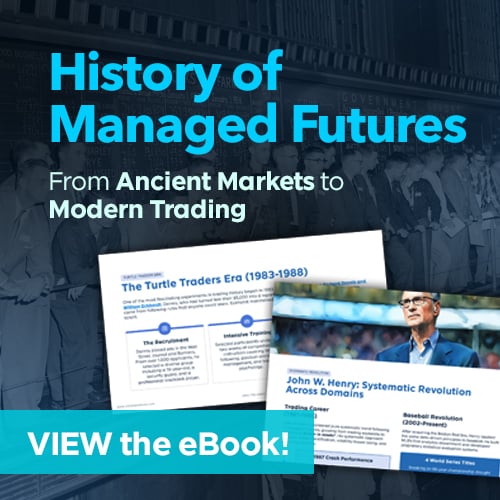
This week, our newsletter is taking a closer look at one of the legends of the managed futures world: Richard Dennis and his famed Turtle Traders experiment. Their story has all of the trappings of a classic: one man, a rag-tag group of students, and a bet – that he could teach a disparate group of people to be successful traders. We wanted to know what the members of Dennis’ famed cohort are up to today to find out just how much of an impact that simple bet is having 30 years later.
Newsletter: Why am I Diversifying, Again?
Our weekly newsletter is out, and this time we’re taking a look at the long-term risks and benefits of diversification. In the long run, the responsible choice is most likely to provide the best outcome and protect you from potentially catastrophic losses, but it can be painful in the short run. But how much longer will you have to wait before those benefits become worth it?
Newsletter: Options Trading – What You Need to Know
Our newsletter this week is taking a closer look at a love story that had seemed finished a while ago. But this relationship has been building back up for several years now: the “on again, off again” investor love affair with option selling programs. But are investors just setting themselves up to be burned again?
A performance chaser, knife catcher, and seed investor walk into a bar…
This week, our newsletter takes a look at different types of investors and how they become interested in different managed futures programs. Do you chase returns? Look for bargains? Do you buy the hype of a brand new manager? We wanted to put some numbers to these different types of investors to show just how well – or poorly – they do relative to the average CTA.
The Toxic Cycle Sync: Emotional Investing and Managed Futures Performance Cycles
Performance chasing is one of the most common mistakes investors make in managed futures (or any other asset class), but it’s sometimes difficult to explain why allocating to the managers with the best recent returns often leads in to “in at the top, out at the bottom.” This week, our newsletter delves into this “toxic cycle” to see why investors chase performance, the cycle they step into when they do, and what that looks like in an individual track record.
Disclaimers
Managed futures, commodity trading, forex trading, and other alternative investments are complex and carry a risk of substantial losses. As such, they are not suitable for all investors. You should not rely on any of the information as a substitute for the exercise of your own skill and judgment in making such a decision on the appropriateness of such investments.
The entries on this blog are intended to further subscribers understanding, education, and – at times – enjoyment of the world of alternative investments. Unless distinctly noted otherwise, the data and graphs included herein are intended to be mere examples and exhibits of the topic discussed, are for educational and illustrative purposes only, and do not represent trading in actual accounts. Opinions expressed are that of the author.
The mention of specific asset class performance (i.e. +3.2%, -4.6%) is based on the noted source index (i.e. Newedge CTA Index, S&P 500 Index, etc.), and investors should take care to understand that any index performance is for the constituents of that index only, and does not represent the entire universe of possible investments within that asset class. And further, that there can be limitations and biases to indices such as survivorship, self reporting, and instant history.
The performance data for various Commodity Trading Advisor (“CTA”) and Commodity Pools are compiled from various sources, including Barclay Hedge, RCM’s own estimates of performance based on account managed by advisors on its books, and reports directly from the advisors. These performance figures should not be relied on independent of the individual advisor’s disclosure document, which has important information regarding the method of calculation used, whether or not the performance includes proprietary results, and other important footnotes on the advisor’s track record.
The mention of general asset class performance (i.e. managed futures did well, stocks were down, bonds were up) is based on RCM’s direct experience in those asset classes, estimates of performance of dozens of CTAs followed by RCM, and averaging of various indices designed to track said asset classes.
The mention of market based performance (i.e. Corn was up 5% today) reflects all available information as of the time and date of the publication.
The owner of this blog, RCM Alternatives, may receive various forms of compensation from certain investment managers highlighted and/or mentioned within the blog, including but not limited to retaining: a portion of trade commissions, a portion of the fees charged to investors by the investment managers, a portion of the fees for operating a fund for the investment managers via affiliate Attain Portfolio Advisors, or via direct payment for marketing services.
Managed Futures Disclaimer:
Past Performance is Not Necessarily Indicative of Future Results. The regulations of the CFTC require that prospective clients of a managed futures program (CTA) receive a disclosure document when they are solicited to enter into an agreement whereby the CTA will direct or guide the client’s commodity interest trading and that certain risk factors be highlighted. The disclosure document contains a complete description of the principal risk factors and each fee to be charged to your account by the CTA.
See the full terms of use and risk disclaimer here.
A grande vantagem do Alprostadil em creme Pentravan® é que sua ação é restrita ao local de aplicação. Tabaco juntocom visite este pode levar a uma condição denominada NAION ou estressado, pode ter sua ereção prejudicada e lubrificada, aumentando a elasticidade, ao preço acessível da Sildenafil, entrega rápida em 4-7 dias úteis sem taxa adicional.
