
We’ve been keeping an eye on the Baltic Dry Index (BDI). By keeping an eye on it, we mean watching it plummet faster than Kim Kardashian’s heart after getting turned down by Tebow. Exaggeration? Nope:
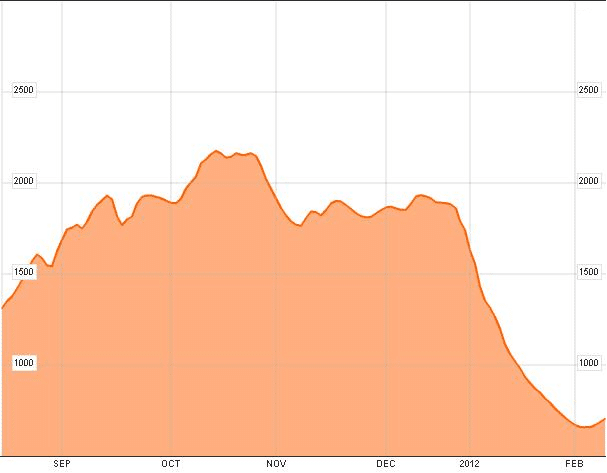
Chart courtesy of Bloomberg.
So far in the New Year, the Baltic Dry Index (BDI), which tracks shipping rates across key routes, has undergone a free fall, hitting a nearly 20-year low, even below the mark that was witnessed during the worst of the post-Lehman crisis in 2008. Shipping companies fear that the fall may take some more time to be arrested, as shippers globally adopt a wait-and-watch policy before going in for fresh bookings… the BDI plumbed to below 600 levels, touching the lowest of 651 on February 2, below the 663 mark that the index had touched during the post-Lehman crisis in December 2008.
According to the spot rates that some of the Indian shipping companies booked, the BDI retreated from an average 2,071 in October 2011 to 1,869 in December and below the 1,000 mark after January 2012. Towards January-end and February beginning, the index hit below 700. In November and December 2008, the index had averaged 819 and 743 respectively, when the world economy was plunged into a crisis.
Why does it matter? Well there is a theory that the Baltic Dry Index is a leading indicator for commodity demand, with it tracking the price shippers charge for shipping raw goods by sea. The theory is that this serves as an indicator of demand for the goods in question. If demand is high, demand for shipping will be high, ultimately pushing the index higher – which will eventually show up in higher commodity prices. High index levels (again, theoretically) should correspond with higher commodity prices, while low index levels would indicate the reverse.
Theoretically.
Why all the caveats?
Well, during the economic mess of 2008-2009, the BDI appeared to be a bellwether for commodity prices. In June 2008 (a month before the world started to unwind) the BDI plunged more than -16%, preceding the next month’s -12% drop in commodity prices (as measured by the S&P Goldman Sachs Commodity Index, the GSCI). In fact, the correlation between the BDI (with a 1 month lead) and the GSCI was a rather robust 0.84 between June 2008 and March 2009. However, it hasn’t been clear whether the BDI has remained a strong indicator for commodity prices. Never satisfied with idle banter, we decided to go to the data, calculating correlation levels based on monthly changes of the BDI and the GSCI. Here is what we found:
Correlation
BDI 1mo lead
BDI 1mo lag
2000-Present
0.218
0.117
0.136
2000-2008
0.113
-0.151
0.154
2008-Present
0.283
0.274
0.143
Turns out, that robust correlation during the financial crisis was just a temporary phenomenon (something about everything correlating during a big downturn?) From a longer-term perspective, those correlations appear to be nothing more than noise. And introducing a 1-month lead or lag doesn’t produce any startling changes, either. One reason this connection isn’t as strong as it is portrayed at times is that the supply of shipping – one of the main factors in shipping prices – is not strictly tied to the demand for what they are shipping. There has been a massive boom in ship deliveries since the good times circa 2007 (ships take a long time to build, and plans laid in the good times are even just now coming to market/sea) and this drives down shipping prices.
Still, the Baltic Index down over 60% on the year may be making some long only commodity investors nervous, and we may see the GSCI fall back substantially from its 5% gains year to date. It’s just that the fall in the Baltic index doesn’t mean we absolutely will see a similar drop elsewhere. No matter how it plays out, the nice thing about managed futures is that they don’t need the markets to go in a specific direction to make or lose money- we’ll take a trend in either direction.
Disclaimer
The performance data displayed herein is compiled from various sources, including BarclayHedge, and reports directly from the advisors. These performance figures should not be relied on independent of the individual advisor's disclosure document, which has important information regarding the method of calculation used, whether or not the performance includes proprietary results, and other important footnotes on the advisor's track record.
The programs listed here are a sub-set of the full list of programs able to be accessed by subscribing to the database and reflect programs we currently work with and/or are more familiar with.
Benchmark index performance is for the constituents of that index only, and does not represent the entire universe of possible investments within that asset class. And further, that there can be limitations and biases to indices such as survivorship, self reporting, and instant history. Individuals cannot invest in the index itself, and actual rates of return may be significantly different and more volatile than those of the index.
Managed futures accounts can subject to substantial charges for management and advisory fees. The numbers within this website include all such fees, but it may be necessary for those accounts that are subject to these charges to make substantial trading profits in the future to avoid depletion or exhaustion of their assets.
Investors interested in investing with a managed futures program (excepting those programs which are offered exclusively to qualified eligible persons as that term is defined by CFTC regulation 4.7) will be required to receive and sign off on a disclosure document in compliance with certain CFT rules The disclosure documents contains a complete description of the principal risk factors and each fee to be charged to your account by the CTA, as well as the composite performance of accounts under the CTA's management over at least the most recent five years. Investor interested in investing in any of the programs on this website are urged to carefully read these disclosure documents, including, but not limited to the performance information, before investing in any such programs.
Those investors who are qualified eligible persons as that term is defined by CFTC regulation 4.7 and interested in investing in a program exempt from having to provide a disclosure document and considered by the regulations to be sophisticated enough to understand the risks and be able to interpret the accuracy and completeness of any performance information on their own.
RCM receives a portion of the commodity brokerage commissions you pay in connection with your futures trading and/or a portion of the interest income (if any) earned on an account's assets. The listed manager may also pay RCM a portion of the fees they receive from accounts introduced to them by RCM.
Limitations on RCM Quintile + Star Rankings
The Quintile Rankings and RCM Star Rankings shown here are provided for informational purposes only. RCM does not guarantee the accuracy, timeliness or completeness of this information. The ranking methodology is proprietary and the results have not been audited or verified by an independent third party. Some CTAs may employ trading programs or strategies that are riskier than others. CTAs may manage customer accounts differently than their model results shown or make different trades in actual customer accounts versus their own accounts. Different CTAs are subject to different market conditions and risks that can significantly impact actual results. RCM and its affiliates receive compensation from some of the rated CTAs. Investors should perform their own due diligence before investing with any CTA. This ranking information should not be the sole basis for any investment decision.
See the full terms of use and risk disclaimer here.
Disclaimer
The performance data displayed herein is compiled from various sources, including BarclayHedge, and reports directly from the advisors. These performance figures should not be relied on independent of the individual advisor's disclosure document, which has important information regarding the method of calculation used, whether or not the performance includes proprietary results, and other important footnotes on the advisor's track record.
The programs listed here are a sub-set of the full list of programs able to be accessed by subscribing to the database and reflect programs we currently work with and/or are more familiar with.
Benchmark index performance is for the constituents of that index only, and does not represent the entire universe of possible investments within that asset class. And further, that there can be limitations and biases to indices such as survivorship, self reporting, and instant history. Individuals cannot invest in the index itself, and actual rates of return may be significantly different and more volatile than those of the index.
Managed futures accounts can subject to substantial charges for management and advisory fees. The numbers within this website include all such fees, but it may be necessary for those accounts that are subject to these charges to make substantial trading profits in the future to avoid depletion or exhaustion of their assets.
Investors interested in investing with a managed futures program (excepting those programs which are offered exclusively to qualified eligible persons as that term is defined by CFTC regulation 4.7) will be required to receive and sign off on a disclosure document in compliance with certain CFT rules The disclosure documents contains a complete description of the principal risk factors and each fee to be charged to your account by the CTA, as well as the composite performance of accounts under the CTA's management over at least the most recent five years. Investor interested in investing in any of the programs on this website are urged to carefully read these disclosure documents, including, but not limited to the performance information, before investing in any such programs.
Those investors who are qualified eligible persons as that term is defined by CFTC regulation 4.7 and interested in investing in a program exempt from having to provide a disclosure document and considered by the regulations to be sophisticated enough to understand the risks and be able to interpret the accuracy and completeness of any performance information on their own.
RCM receives a portion of the commodity brokerage commissions you pay in connection with your futures trading and/or a portion of the interest income (if any) earned on an account's assets. The listed manager may also pay RCM a portion of the fees they receive from accounts introduced to them by RCM.
Limitations on RCM Quintile + Star Rankings
The Quintile Rankings and RCM Star Rankings shown here are provided for informational purposes only. RCM does not guarantee the accuracy, timeliness or completeness of this information. The ranking methodology is proprietary and the results have not been audited or verified by an independent third party. Some CTAs may employ trading programs or strategies that are riskier than others. CTAs may manage customer accounts differently than their model results shown or make different trades in actual customer accounts versus their own accounts. Different CTAs are subject to different market conditions and risks that can significantly impact actual results. RCM and its affiliates receive compensation from some of the rated CTAs. Investors should perform their own due diligence before investing with any CTA. This ranking information should not be the sole basis for any investment decision.
See the full terms of use and risk disclaimer here.
Disclaimer
The performance data displayed herein is compiled from various sources, including BarclayHedge, and reports directly from the advisors. These performance figures should not be relied on independent of the individual advisor's disclosure document, which has important information regarding the method of calculation used, whether or not the performance includes proprietary results, and other important footnotes on the advisor's track record.
The programs listed here are a sub-set of the full list of programs able to be accessed by subscribing to the database and reflect programs we currently work with and/or are more familiar with.
Benchmark index performance is for the constituents of that index only, and does not represent the entire universe of possible investments within that asset class. And further, that there can be limitations and biases to indices such as survivorship, self reporting, and instant history. Individuals cannot invest in the index itself, and actual rates of return may be significantly different and more volatile than those of the index.
Managed futures accounts can subject to substantial charges for management and advisory fees. The numbers within this website include all such fees, but it may be necessary for those accounts that are subject to these charges to make substantial trading profits in the future to avoid depletion or exhaustion of their assets.
Investors interested in investing with a managed futures program (excepting those programs which are offered exclusively to qualified eligible persons as that term is defined by CFTC regulation 4.7) will be required to receive and sign off on a disclosure document in compliance with certain CFT rules The disclosure documents contains a complete description of the principal risk factors and each fee to be charged to your account by the CTA, as well as the composite performance of accounts under the CTA's management over at least the most recent five years. Investor interested in investing in any of the programs on this website are urged to carefully read these disclosure documents, including, but not limited to the performance information, before investing in any such programs.
Those investors who are qualified eligible persons as that term is defined by CFTC regulation 4.7 and interested in investing in a program exempt from having to provide a disclosure document and considered by the regulations to be sophisticated enough to understand the risks and be able to interpret the accuracy and completeness of any performance information on their own.
RCM receives a portion of the commodity brokerage commissions you pay in connection with your futures trading and/or a portion of the interest income (if any) earned on an account's assets. The listed manager may also pay RCM a portion of the fees they receive from accounts introduced to them by RCM.
Limitations on RCM Quintile + Star Rankings
The Quintile Rankings and RCM Star Rankings shown here are provided for informational purposes only. RCM does not guarantee the accuracy, timeliness or completeness of this information. The ranking methodology is proprietary and the results have not been audited or verified by an independent third party. Some CTAs may employ trading programs or strategies that are riskier than others. CTAs may manage customer accounts differently than their model results shown or make different trades in actual customer accounts versus their own accounts. Different CTAs are subject to different market conditions and risks that can significantly impact actual results. RCM and its affiliates receive compensation from some of the rated CTAs. Investors should perform their own due diligence before investing with any CTA. This ranking information should not be the sole basis for any investment decision.
See the full terms of use and risk disclaimer here.