
Dear Mom…

Working in finance, you learn not to talk shop too much with family members. It’s a little easier for us to avoid typically. They ask us for a stock recommendation, we say we don’t do stocks, they get a blank look on their face, and we change the subject. But seriously, talking finance with family members can be the headache from hell when you’re working in it day in and day out. Take the following conversation one of the people in our office had with their under 50 mother – a necessary one, but facepalm status nonetheless:

Daughter: Mom, when was the last time you talked to your adviser?

Mom: We’re fine.

Daughter: Mom, seriously, when was the last time you went over your portfolio?

Mom: It’s ok- we’ve got plenty of time. Everything will work out over the long term.

Daughter: You’re young, you’re right, but that doesn’t mean you shouldn’t be diligent about these things. Do you know what’s in your portfolio?

Mom: Sure, it’s fine. Seriously- we’ve got all the time in the world.

Translation: she doesn’t really know what’s in there or why, so she’s just repeating the excuse given to her by her adviser. The excuse itself bears scrutiny, though: Time. Funny word, that. Unfortunately, most of us don’t have time, but will instead be forced to work overtime in the big picture just to make ends meet during retirement. US News and World Report states:

Most Americans no longer aspire to retire early. Workers are increasingly pushing back their desired retirement age and wondering if they will be able to retire at all.

The age workers expect to retire has increased from an average of 60 in 1995 to 66 in 2011, according to a Gallup poll. The proportion of people aiming to retire early has plummeted from 50 percent in 1995 to 28 percent in 2011. Most Americans now expect to retire at age 65 or later.

“It’s just not possible for people to work for 30 or 40 years and support themselves on their assets for another 20 or 30 years,” says Alicia Munnell, director of the Center for RetirementResearch at Boston College. “Many people saw their 401(k)s decimated by the recession, and many people also saw their house lose value.”

The recession has accelerated the trend of Americans pushing back their retirement date. Almost half (46 percent) of people age 50 and older say they now plan to retire at a later age than they did three years ago, and the reason is often because the value of their 401(k) and other retirement investments has declined, according to a recent Towers Watson survey. Unsurprisingly, workers depending on their 401(k)s to finance retirement are planning longer delays than people with a traditional pension.

All that time you thought you had? Well, you may have an additional ten to twenty to wait – not out of choice, but necessity. That’s not the kind of time you want to have.

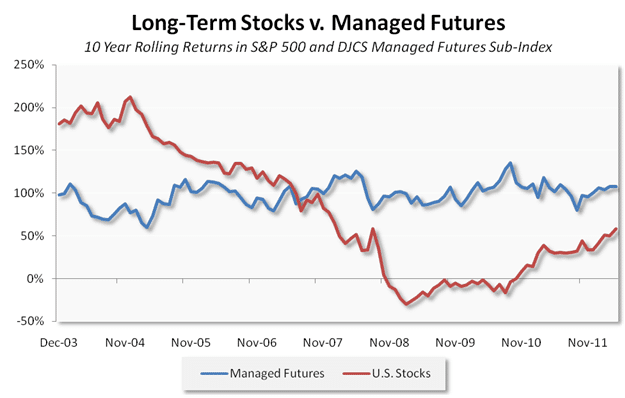
The whole concept of having a lot of time before you retire feeds into the ideas guiding your investment portfolio. When you have time, the buy and hold strategy looks pretty attractive. But how, exactly, is that working out? Well, had you started using this strategy back between 1993 and 1996, it might have been a winning strategy for you over a ten-year period. However, if you look at the chart below, you’ll notice that the ten-year rolling return for an investment in the S&P 500, used here as an imperfect proxy for stock exposure, actually dipped into negative territory for a full two-year time period.
Disclaimer: Past performance is not necessarily indicative of future results.

The more interesting thing to note, though, is the blue line – managed futures performance per the Dow Jones Credit Suisse Managed Futures Sub-Index. Assuming a world where this index were investable (it’s not), you’d notice that managed futures rolling ten year returns are actually increasing relative to the same measure for stocks. In fact, the average 10-year rolling return for managed futures was 99%, while the average for stocks was 79%. And as a gloating aside – note that the managed futures line never once dipped into negative territory the way stocks did.

To be fair, past performance is not necessarily indicative of future results, and managed futures, because of the risks involved, is never going to be right for every investor. The illustration above is not a perfect representation – it’s just a snapshot that we hope makes you think about “time” and planning a little differently. It’s not that we don’t think you should look at investing over the long-term, because we do. Managed futures investments should have a minimum timeframe of three to five years, in our opinion. What we’re saying is that even when you do look at the long term, there are still potentially better options than the traditional investments you’ve been looking at. Even if you do want to invest with longer timeframes, you can do better than a traditional buy and hold approach.

Sigh. Oh, Parents. We’ve become them, in many ways – nagging them to look at their portfolios, chasing around rugrats of our own. We’re suddenly in a position to be giving them advice – just make sure you’re listening to the advice you dole out as well.

Write a Comment

Disclaimer
The performance data displayed herein is compiled from various sources, including BarclayHedge, and reports directly from the advisors. These performance figures should not be relied on independent of the individual advisor's disclosure document, which has important information regarding the method of calculation used, whether or not the performance includes proprietary results, and other important footnotes on the advisor's track record.

The programs listed here are a sub-set of the full list of programs able to be accessed by subscribing to the database and reflect programs we currently work with and/or are more familiar with.

Benchmark index performance is for the constituents of that index only, and does not represent the entire universe of possible investments within that asset class. And further, that there can be limitations and biases to indices such as survivorship, self reporting, and instant history. Individuals cannot invest in the index itself, and actual rates of return may be significantly different and more volatile than those of the index.

Managed futures accounts can subject to substantial charges for management and advisory fees. The numbers within this website include all such fees, but it may be necessary for those accounts that are subject to these charges to make substantial trading profits in the future to avoid depletion or exhaustion of their assets.

Investors interested in investing with a managed futures program (excepting those programs which are offered exclusively to qualified eligible persons as that term is defined by CFTC regulation 4.7) will be required to receive and sign off on a disclosure document in compliance with certain CFT rules The disclosure documents contains a complete description of the principal risk factors and each fee to be charged to your account by the CTA, as well as the composite performance of accounts under the CTA's management over at least the most recent five years. Investor interested in investing in any of the programs on this website are urged to carefully read these disclosure documents, including, but not limited to the performance information, before investing in any such programs.

Those investors who are qualified eligible persons as that term is defined by CFTC regulation 4.7 and interested in investing in a program exempt from having to provide a disclosure document and considered by the regulations to be sophisticated enough to understand the risks and be able to interpret the accuracy and completeness of any performance information on their own.

RCM receives a portion of the commodity brokerage commissions you pay in connection with your futures trading and/or a portion of the interest income (if any) earned on an account's assets. The listed manager may also pay RCM a portion of the fees they receive from accounts introduced to them by RCM.

Limitations on RCM Quintile + Star Rankings

The Quintile Rankings and RCM Star Rankings shown here are provided for informational purposes only. RCM does not guarantee the accuracy, timeliness or completeness of this information. The ranking methodology is proprietary and the results have not been audited or verified by an independent third party. Some CTAs may employ trading programs or strategies that are riskier than others. CTAs may manage customer accounts differently than their model results shown or make different trades in actual customer accounts versus their own accounts. Different CTAs are subject to different market conditions and risks that can significantly impact actual results. RCM and its affiliates receive compensation from some of the rated CTAs. Investors should perform their own due diligence before investing with any CTA. This ranking information should not be the sole basis for any investment decision.

See the full terms of use and risk disclaimer here.

Disclaimer
The performance data displayed herein is compiled from various sources, including BarclayHedge, and reports directly from the advisors. These performance figures should not be relied on independent of the individual advisor's disclosure document, which has important information regarding the method of calculation used, whether or not the performance includes proprietary results, and other important footnotes on the advisor's track record.

The programs listed here are a sub-set of the full list of programs able to be accessed by subscribing to the database and reflect programs we currently work with and/or are more familiar with.

Benchmark index performance is for the constituents of that index only, and does not represent the entire universe of possible investments within that asset class. And further, that there can be limitations and biases to indices such as survivorship, self reporting, and instant history. Individuals cannot invest in the index itself, and actual rates of return may be significantly different and more volatile than those of the index.

Managed futures accounts can subject to substantial charges for management and advisory fees. The numbers within this website include all such fees, but it may be necessary for those accounts that are subject to these charges to make substantial trading profits in the future to avoid depletion or exhaustion of their assets.

Investors interested in investing with a managed futures program (excepting those programs which are offered exclusively to qualified eligible persons as that term is defined by CFTC regulation 4.7) will be required to receive and sign off on a disclosure document in compliance with certain CFT rules The disclosure documents contains a complete description of the principal risk factors and each fee to be charged to your account by the CTA, as well as the composite performance of accounts under the CTA's management over at least the most recent five years. Investor interested in investing in any of the programs on this website are urged to carefully read these disclosure documents, including, but not limited to the performance information, before investing in any such programs.

Those investors who are qualified eligible persons as that term is defined by CFTC regulation 4.7 and interested in investing in a program exempt from having to provide a disclosure document and considered by the regulations to be sophisticated enough to understand the risks and be able to interpret the accuracy and completeness of any performance information on their own.

RCM receives a portion of the commodity brokerage commissions you pay in connection with your futures trading and/or a portion of the interest income (if any) earned on an account's assets. The listed manager may also pay RCM a portion of the fees they receive from accounts introduced to them by RCM.

Limitations on RCM Quintile + Star Rankings

The Quintile Rankings and RCM Star Rankings shown here are provided for informational purposes only. RCM does not guarantee the accuracy, timeliness or completeness of this information. The ranking methodology is proprietary and the results have not been audited or verified by an independent third party. Some CTAs may employ trading programs or strategies that are riskier than others. CTAs may manage customer accounts differently than their model results shown or make different trades in actual customer accounts versus their own accounts. Different CTAs are subject to different market conditions and risks that can significantly impact actual results. RCM and its affiliates receive compensation from some of the rated CTAs. Investors should perform their own due diligence before investing with any CTA. This ranking information should not be the sole basis for any investment decision.

See the full terms of use and risk disclaimer here.

logo