

Traditionally, when you read a story, the moral comes at the end – a sound bite takeaway that justifies the time spent. We’re going to try something a little different, though, and provide the moral of the story up front. See, this story has a lot of moving pieces, and it can be all too easy to focus on one point, missing the forest for the trees. So before you even get started here, remember:
Nothing happens in a vacuum.
Chaos has erupted in the Middle East, and there’s no easy way to stem the tide. In Afghanistan, terrorists disguised in U.S. uniforms infiltrated our military bases, resulting in suspended joint operations that inevitably extend the conflict. In Libya, premeditated attacks resulted in the death of a U.S. ambassador. Anti-western sentiment has fueled protests in 20 separate nations. In Syria, what started as a small uprising is now full-blown civil war, with various actors in the region providing weapons and support to the rebels. Iran has shown renewed defiance in the face of international pressure regarding their nuclear program, repeating threats of wiping Israel off the face of the map, and the U.S. has begun to ramp up their language about consequences.
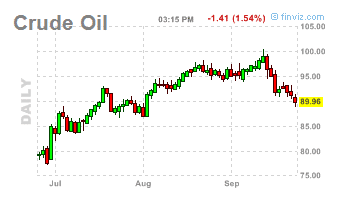
This kind of unrest and violence has the potential to upend an already volatile region, and that’s putting it lightly. With so much uncertainty, one would typically expect oil to be surging to new highs, yet oil today dips below $90 a barrel.
Nothing happens in a vacuum.
Yes, the violence and uncertainty in the Middle East may present concerns about supply, but there are serious questions about global consumption in the coming months and years, and with good reason.
For a very brief, beautiful window of time, it appeared as though we might be done talking about the Euro Crisis. After months upon months of turbulent debate over how best to stabilize the economies in the region, leadership announced a bold bond buying program, spearheaded by the ECB, and a reticent Germany was likely to provide support, however tepid. The markets, finally, had stopped responding to every little rumor on the continent as though they had mood altering drugs being piped in through a direct line.
Those were the days! Well, maybe “the minutes.”
The thing is, the discussion of these Euro Crisis solutions, how they might be implemented, and what their impact would be, took place in a very controlled environment. The markets held onto the belief that leadership would ultimately do whatever necessary to fix the situation, regardless of how many ups and downs came in between. After all, if individual banks could be considered too big to fail, surely the economies of entire nations qualified for the same sort of consideration.
And in some ways, such expectations make sense. If you look at the big picture, analyzing economic realities from a distance, such decisions were, of course, inevitable, with austerity-conditioned aid a near certainty. Political leadership would have to make decisions rationally, and in that case, the ending was predetermined. Except, such calculus ignored the one element that never depended on what is rational for everyone:
The people.
Austerity measures, on paper, merely represent a number in an equation, but for the people the austerity measures impact, that couldn’t be further from the truth. A budget cut in some of these nations could be the difference between employment and the bread line; between a roof over your head or a box in the street; between dignity and despair. With economically driven suicide rates on the rise across Europe, this isn’t about what’s rational in the long run or the big picture; it’s about what comes tomorrow.
So are the scenes we see rolling across our screens really all that surprising? In Greece, what started as a general strike has transformed into violent riots, where protestors hurl petrol bombs at police forces. In Spain, as leadership attempts to pen austerity proposals, thousands of protestors surround cops sent to control the masses. They say a picture is worth a thousand words…
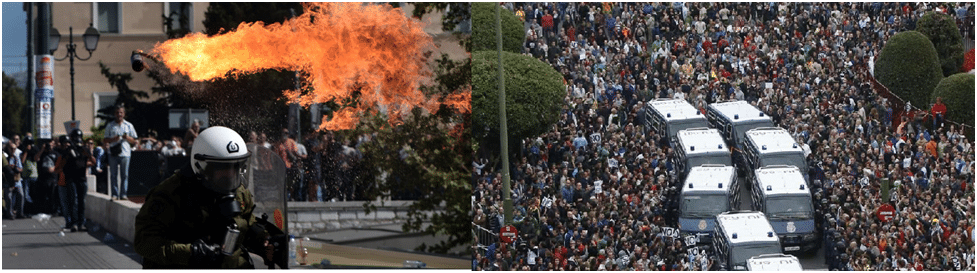
… but even that doesn’t tell the whole story. While the violent images are a jarring reminder of why we can’t assume a rational decision making paradigm on these important issues, it’s not the only complication in this crisis. While protests erupt in Spain and Greece, Portugal is looking more like Greece by the day. Italy’s economy continues to contract, as the population feels the pain of austerity measures coming into effect without additional aid. France is far from strong, and even Germany – often regarded as the last, best hope for Europe – is seeing their economy start to soften. Commitment to maintaining the Euro Zone, while admirable in principle, almost guarantees more pain to come.
And nothing happens in a vacuum.
Europe is in crisis; there’s no denying that. But Europe isn’t the Alpha and Omega of the global economy, which brings us to the BRIC nations. Brazil, Russia, India and China may have been given the nod by Goldman Sachs 11 years ago, but today, their prospects for ongoing growth appear dismal. Inflation is plaguing the countries, with Brazil seeing consumer prices jump 5.2% in July, Russia 5.6%, and India a whopping 9.86% headed into Monsoon season after record drought conditions. China came it at much slower increase of 1.8%, but they’re not out of the woods, as they stare down their 9th straight quarter of economic slowdown, with their stock market plummeting to 2009 lows.
And this is just what we know. As the New York Times reported earlier this year, there are major concerns about the validity of data coming out of China – arguably the most important of the BRIC economies:
As the Chinese economy continues to sputter, prominent corporate executives in China and Western economists say there is evidence that local and provincial officials are falsifying economic statistics to disguise the true depth of the troubles.
Record-setting mountains of excess coal have accumulated at the country’s biggest storage areas because power plants are burning less coal in the face of tumbling electricity demand. But local and provincial government officials have forced plant managers not to report to Beijing the full extent of the slowdown, power sector executives said.
Electricity production and consumption have been considered a telltale sign of a wide variety of economic activity. They are widely viewed by foreign investors and even some Chinese officials as the gold standard for measuring what is really happening in the country’s economy, because the gathering and reporting of data in China is not considered as reliable as it is in many countries.
Indeed, officials in some cities and provinces are also overstating economic output, corporate revenue, corporate profits and tax receipts, the corporate executives and economists said. The officials do so by urging businesses to keep separate sets of books, showing improving business results and tax payments that do not exist.
The executives and economists roughly estimated that the effect of the inaccurate statistics was to falsely inflate a variety of economic indicators by 1 or 2 percentage points. That may be enough to make very bad economic news look merely bad.
This type of economic concern is shadowed by several years of highly publicized fraud in the private sector (Sino Forest, anyone?) in a heavily controlled information flow, leaving us to wonder what lies beneath the surface. In Russia, other vulnerabilities persist. As Reuters reports:
A lending spree by Russian banks may be piling up problems for the sector in future, especially if a sharp fall in oil prices puts a stop on the country’s economic growth, a senior central bank official warned on Tuesday. […]
Recent stress tests by the central bank show the number of domestic lenders that could face capital shortfalls under an “extreme” scenario – where a drop in oil prices drags down the economy – has risen 2.5 times since earlier this year, he said.
A sharp fall in oil prices? Poorly prepared banks with too much debt on the books? Sound familiar? There’s a lot of weakness in these regions- regions where consumer habits and juggernaut growth have been viewed as a safety net for the global economy.
And nothing happens in a vacuum.
In an election season saturated with economic laments, how ironic that the U.S. looks strong by comparison. Stocks are up over 95% since 2009, home sales are finally on what looks like a firm road to recovery, and consumer sentiment is soaring upward. But at the same time, unemployment is at 8.3%, and debate over how to buoy the job market is running hot. Still, those debates are taking place in the dreaded vacuum – with solutions and efficacy being placed squarely on the shoulders of the presidency, and perhaps, as Josh Brown explains, in a place far, far away from reality:
Which brings me to the US equity markets, which are coming off of a virtually uninterrupted melt-up since the end of June, with virtually every sector and stock participating regardless of economic sensitivity. This in the face of eroding fundamentals for many bellwether stocks and industry groups, Fedex and Caterpillar being just the latest examples to tell us how lousy things are.
But we ignored the fundamentals and rampaged higher on sentiment. This is how you explain a stock market that runs up 15% with no change in earnings estimates for the forward two quarters. The improvement in sentiment – driven by the assumption and then confirmation of permanent Fed support – is responsible for virtually all of your portfolio’s gains since the Summer Solstice, no offense to the regard with which you hold your stock-picking abilities. Even the most bullish strategists with the highest year-end S&P targets acknowledged that multiple expansion was the key ingredient for their forecasts, none of them were looking for an acceleration in fundamentals by year-end.
In short, we built a Castle on a Cloud, the accumulated moisture of performance-chasing and confidence were its only foundation. And now, with European markets back in turmoil – with all of the volatility and drama that brings – the only question is whether or not our Castle on a Cloud can remain aloft, above the disturbances at ground level.
That’s the thing about Castles on Clouds – a surrounding siege army is not required for them to fall, only a change in air current that dissipates the molecules.
But what on earth could change that air current? Setting aside the first thousand words here, there’s this little thing called the Fiscal Cliff. As a reminder, the Cliff references a combination of events that would play out over November and December of this year. With a redux of last August’s debt ceiling debate coming around, the lame duck Congress will also be trying desperately to avoid a series of tax cut expirations and scheduled spending slashes set to take effect on the first of the year – the cumulative impact of which is the shrinking of the economy and exacerbation of current pains. With Republicans firmly opposed to any form of tax increase, Democrats unwilling to cut spending without some offsetting revenue, and their “Do Nothing Congress” moniker based on a partisan gridlock without comparison, a change in the current isn’t all that hard to envision.
And nothing happens in a vacuum.
In his United Nations address yesterday, President Obama referenced the impact of technology on the connectivity of message and audience, but it’s not just the stories we tell that connect us. The best example of the shared narrative- the “common heartbeat to humanity”- is how synced up our economic heartbeat has become. Call it a castle on a cloud, house of cards, or personified Bon Jovi lyric, but things are far from stable or sustainable right now, particularly in a world where we delude ourselves into thinking all of these things happen in a vacuum and can be addressed in the same manner.
If you’re not thinking in a vacuum, portfolio diversification becomes more important than ever. But it’s not enough to pay diversification lip service with traditional allocation strategies – you have to make sure you have truly non-correlated exposure backing you up. We don’t make a secret of which asset class we think best fits the bill… and we’re more than happy to discuss options.