

With gold falling throughout the end of 2012 and platinum spiking more than 10% since the beginning of 2013, the change has been enough to bring the price of an ounce of gold below that of an ounce of platinum for the first time since April of last year.
Why do we care? Well, the spread between platinum and gold is instructive thanks to the many similarities between the two metals. For one, they’re neighbors on the periodic table of elements and have many similar properties; both are resistant to corrosion and often used in jewelry. They are both rare metals (though platinum is somewhat rarer) and roughly equivalent in difficulty of extracting from the earth.
The main difference from an economic perspective is that platinum has more industrial uses, which means it tends to be more influenced by the “real economy,” while gold has a far more prominent psychological factor in its price. (When’s the last time you heard someone advocate switching our monetary system to the platinum standard?)
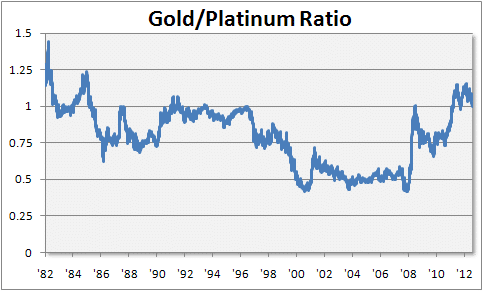
So what does the recent price inversion tell us about gold or platinum? One data point does not a story make, so we compared the front month daily closing price of gold to that of platinum going back to 1982 to see how this relationship has fared over the last few decades:
Disclaimer: past performance is not necessarily indicative of future results.
The spikes in the chart definitely tell a story – platinum’s rise during the dot-com era and again during the ’04 to ’07 boom led to a historically low ratio. Economic crises have had the reverse effect, most noticeable in the massive spike in the ratio during the 2008 financial crisis.
In addition, the last year, with gold selling at a premium to platinum, is definitely unusual from a historical perspective. Over the 30-year history we examined the average ratio between gold at platinum was just below 0.8, meaning it would take a further 20% fall in gold prices relative to platinum just to get back to the historical average. And a return to the 2004-2007 levels would mean an even steeper decline of 50% in gold prices compared to platinum. Of course, this is only the spread, so such an outcome could occur through gold prices rising (but platinum rising faster) or by platinum prices falling (but gold falling faster).
That chart doesn’t give us a clear picture of how the relationship has fared more recently, so we also took closer look at the last two years, and added in a 200 day moving average:

Disclaimer: past performance is not necessarily indicative of future results.
We don’t pretend to be chartists, nor do we have a crystal ball to tell us whether this is a fake out lower or a real breakout that will take us back to the historical average spread between the two metals. There’s certainly a possibility of renewed crisis down the road (when isn’t there?) that could keep gold’s psychological premium over platinum alive and well, but this is one trade that, if it did revert to the mean, would definitely turn some heads.