
Risk On/Risk Off Market Snapshot: February 2013

Keeping tabs on market correlation is a fundamental part of risk management because understanding correlation is key to diversification. If various markets are moving up or down in unison, risk and volatility can quickly grow beyond your expectations. That’s why we’ve started keeping an eye on two statistics that help illustrate how easy or difficult it has been to stay diversified in the futures markets: the risk on/risk off trade, and market correlations.

Risk On, Risk Off

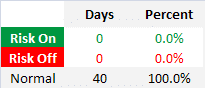
One of the proxies we use to keep track of market dynamics is the number of risk on/risk off days in the year. We define risk on as an average gain of over 1% for “risk” assets; risk off is an average loss of over -1% for “risk” assets. (Click here for a more detailed breakdown.) Now that February is complete, we can update our year-to-date count of these days:
(Disclaimer: past performance is not necessarily indicative of future results.)

That’s right, for the second month in a row, not a single trading day in 2013 has counted as either risk on or risk off according to our definition. How is that possible considering the big swings in the markets we saw this month? Well, for one, those swings weren’t actually very big in an absolute sense – at less than 2% in either direction – we’ve just grown accustomed to the lower volatility we’ve seen throughout 2013. The other reason is that the remaining “risk” markets were soaring on those days – the punishment for stocks wasn’t spilling over into other sectors (like metals and energies) the way that we saw in 2011 and 2012.

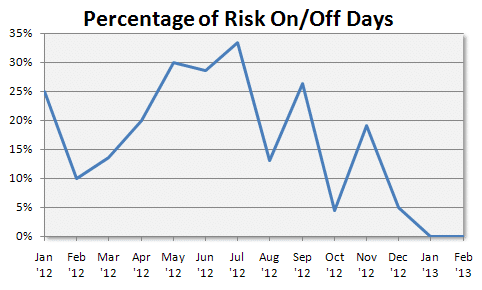
In our 2013 outlook we posited that we might see more of a return to “normal” this year, but we certainly didn’t think we’d see the count collapse to 0% risk on/risk off days. As we pointed out then, the percentage of risk on or risk off days has been declining since 2008, and on a smaller time frame the downward trend is apparent since the spike we saw last May:
(Disclaimer: past performance is not necessarily indicative of future results.)

Prior to 2008, the yearly average of risk on/risk off days stayed between 10% to 20%. It will be a while before we can say that 2013 has completely bucked the trend of roller-coaster years, but starting off the year with two months at 0% is certainly a step in that direction.

Market Correlations

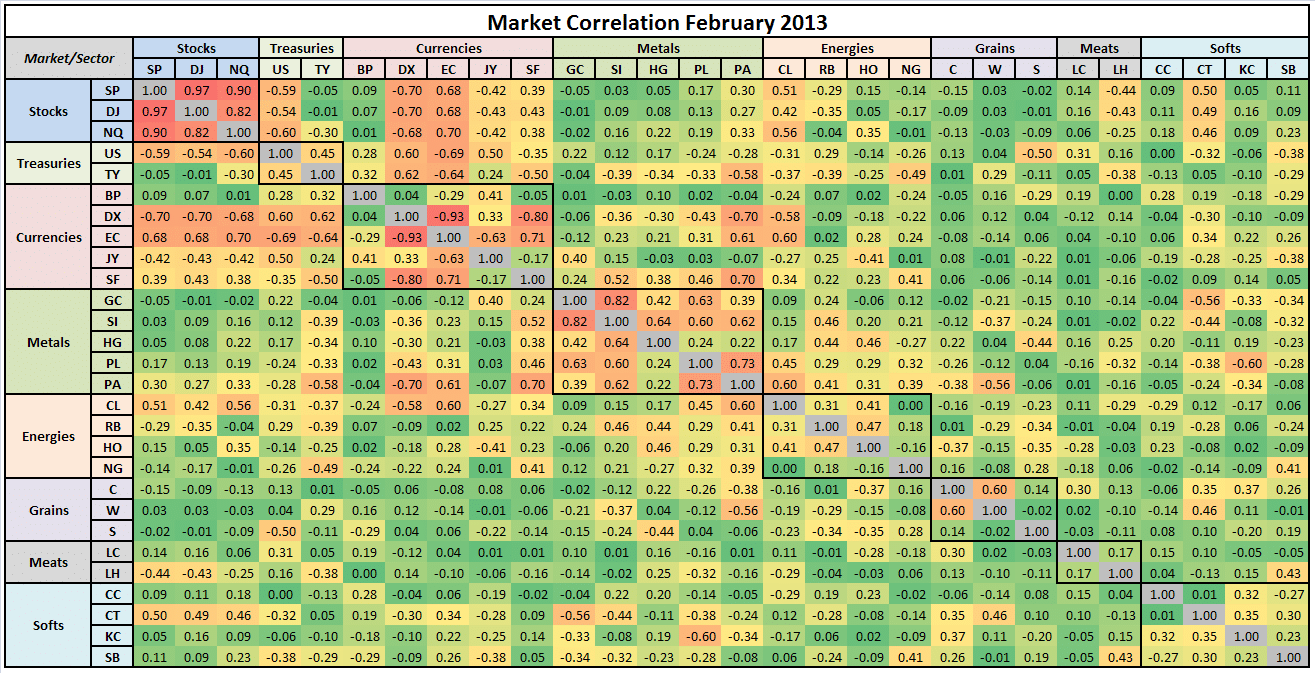
How about correlations? As a refresher, correlation is a statistical measure of how interrelated two sets of data are. A correlation of 1.00 would mean that the markets move in lock-step, and a correlation of -1.00 means that they always move in opposite directions. For diversification value, what we’re looking for is non-correlation (a correlation of 0.00), which would mean that the two markets are behaving as though they are completely unrelated.

The overall market correlation in February was .24, just hair higher than January’s score of .23 (based on the absolute value of all market correlations).That figure is still much lower than the monthly averages we saw throughout 2012, which tended to lie in the .27 to .33 range. These statistics are not perfect measures of the diversity of market activity, but they do indicate that 2013 is off to a more “normal” start. Much can change before the year ends (and it almost certainly will), but for now, we’re not complaining.
Click to embiggen.

Disclaimer: past performance is not necessarily indicative of future results.
Write a Comment

Disclaimer
The performance data displayed herein is compiled from various sources, including BarclayHedge, and reports directly from the advisors. These performance figures should not be relied on independent of the individual advisor's disclosure document, which has important information regarding the method of calculation used, whether or not the performance includes proprietary results, and other important footnotes on the advisor's track record.

The programs listed here are a sub-set of the full list of programs able to be accessed by subscribing to the database and reflect programs we currently work with and/or are more familiar with.

Benchmark index performance is for the constituents of that index only, and does not represent the entire universe of possible investments within that asset class. And further, that there can be limitations and biases to indices such as survivorship, self reporting, and instant history. Individuals cannot invest in the index itself, and actual rates of return may be significantly different and more volatile than those of the index.

Managed futures accounts can subject to substantial charges for management and advisory fees. The numbers within this website include all such fees, but it may be necessary for those accounts that are subject to these charges to make substantial trading profits in the future to avoid depletion or exhaustion of their assets.

Investors interested in investing with a managed futures program (excepting those programs which are offered exclusively to qualified eligible persons as that term is defined by CFTC regulation 4.7) will be required to receive and sign off on a disclosure document in compliance with certain CFT rules The disclosure documents contains a complete description of the principal risk factors and each fee to be charged to your account by the CTA, as well as the composite performance of accounts under the CTA's management over at least the most recent five years. Investor interested in investing in any of the programs on this website are urged to carefully read these disclosure documents, including, but not limited to the performance information, before investing in any such programs.

Those investors who are qualified eligible persons as that term is defined by CFTC regulation 4.7 and interested in investing in a program exempt from having to provide a disclosure document and considered by the regulations to be sophisticated enough to understand the risks and be able to interpret the accuracy and completeness of any performance information on their own.

RCM receives a portion of the commodity brokerage commissions you pay in connection with your futures trading and/or a portion of the interest income (if any) earned on an account's assets. The listed manager may also pay RCM a portion of the fees they receive from accounts introduced to them by RCM.

Limitations on RCM Quintile + Star Rankings

The Quintile Rankings and RCM Star Rankings shown here are provided for informational purposes only. RCM does not guarantee the accuracy, timeliness or completeness of this information. The ranking methodology is proprietary and the results have not been audited or verified by an independent third party. Some CTAs may employ trading programs or strategies that are riskier than others. CTAs may manage customer accounts differently than their model results shown or make different trades in actual customer accounts versus their own accounts. Different CTAs are subject to different market conditions and risks that can significantly impact actual results. RCM and its affiliates receive compensation from some of the rated CTAs. Investors should perform their own due diligence before investing with any CTA. This ranking information should not be the sole basis for any investment decision.

See the full terms of use and risk disclaimer here.

Disclaimer
The performance data displayed herein is compiled from various sources, including BarclayHedge, and reports directly from the advisors. These performance figures should not be relied on independent of the individual advisor's disclosure document, which has important information regarding the method of calculation used, whether or not the performance includes proprietary results, and other important footnotes on the advisor's track record.

The programs listed here are a sub-set of the full list of programs able to be accessed by subscribing to the database and reflect programs we currently work with and/or are more familiar with.

Benchmark index performance is for the constituents of that index only, and does not represent the entire universe of possible investments within that asset class. And further, that there can be limitations and biases to indices such as survivorship, self reporting, and instant history. Individuals cannot invest in the index itself, and actual rates of return may be significantly different and more volatile than those of the index.

Managed futures accounts can subject to substantial charges for management and advisory fees. The numbers within this website include all such fees, but it may be necessary for those accounts that are subject to these charges to make substantial trading profits in the future to avoid depletion or exhaustion of their assets.

Investors interested in investing with a managed futures program (excepting those programs which are offered exclusively to qualified eligible persons as that term is defined by CFTC regulation 4.7) will be required to receive and sign off on a disclosure document in compliance with certain CFT rules The disclosure documents contains a complete description of the principal risk factors and each fee to be charged to your account by the CTA, as well as the composite performance of accounts under the CTA's management over at least the most recent five years. Investor interested in investing in any of the programs on this website are urged to carefully read these disclosure documents, including, but not limited to the performance information, before investing in any such programs.

Those investors who are qualified eligible persons as that term is defined by CFTC regulation 4.7 and interested in investing in a program exempt from having to provide a disclosure document and considered by the regulations to be sophisticated enough to understand the risks and be able to interpret the accuracy and completeness of any performance information on their own.

RCM receives a portion of the commodity brokerage commissions you pay in connection with your futures trading and/or a portion of the interest income (if any) earned on an account's assets. The listed manager may also pay RCM a portion of the fees they receive from accounts introduced to them by RCM.

Limitations on RCM Quintile + Star Rankings

The Quintile Rankings and RCM Star Rankings shown here are provided for informational purposes only. RCM does not guarantee the accuracy, timeliness or completeness of this information. The ranking methodology is proprietary and the results have not been audited or verified by an independent third party. Some CTAs may employ trading programs or strategies that are riskier than others. CTAs may manage customer accounts differently than their model results shown or make different trades in actual customer accounts versus their own accounts. Different CTAs are subject to different market conditions and risks that can significantly impact actual results. RCM and its affiliates receive compensation from some of the rated CTAs. Investors should perform their own due diligence before investing with any CTA. This ranking information should not be the sole basis for any investment decision.

See the full terms of use and risk disclaimer here.

logo