

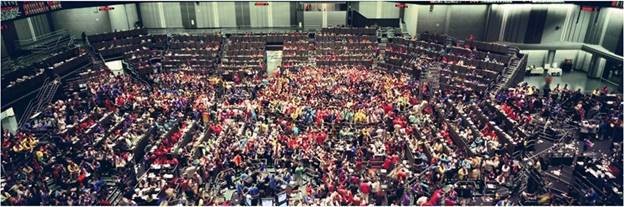
Here’s the Chicago Board of Trade’s trading floor sometime in the 1990s. Down there in that mass of humanity and paper and colored coats were dozens of clerks. These were (mostly) young people getting a foothold in the industry. Learning the ropes from the bottom rung. Interns, if you will, who weren’t just leaning how the markets worked, but also getting as good a look at pure speculation and capitalism as most will see – being offered $1,000 to eat a small tub of sport peppers one day or traders making a market on whether they could throw a football across the Chicago river the next.
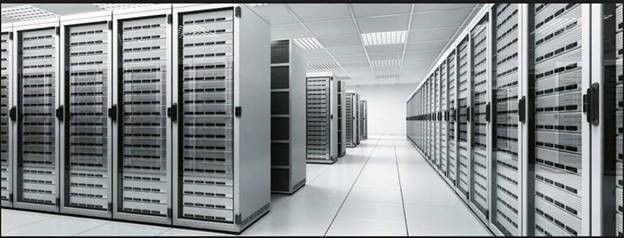
And here’s what the Chicago Board of Trade’s “trading pits” look like today…. (full disclaimer, that’s just a server room, not really their server room, but you get the point).
In many ways – electronic trading is better. For one, the industry has reduced the thousands of reams of paper used each and every day as trading tickets were filled out and ripped up and tossed to the side. More importantly, it eliminates out trades, tightened the bid/ask, and allowed more market participants to access the markets.
But in one big way, the death of Chicago’s famed trading pits has one very big negative – the loss of a fertile breeding ground for young people to learn the industry and turn that into a career. That organized chaos that was the trading pits produced hundreds upon hundreds of young clerks that were smart, hungry, driven individuals. Their pit experience allowed them to learn the industry, make contacts, and bridge the gap from hazed gopher to trader or broker or hedge fund manager. It was like the turtle trader experiment on steroids, happening 5 days a week for dozens upon dozens of years.
RCM University Program
So with the pits dying and trading moving inexorably to electronic, automated and even high-frequency trading, where will the next wave of talent come from? How will the industry fill the talent void it is facing? John Lothian has been active in this endeavor for quite some time via his MarketsWiki World of Opportunity Series, where those with interest are exposed to financial markets via talks and meetups and the like. We applaud those efforts, but tackle the problem a little bit differently on our side, thinking it’s one thing to hear how the markets work – and quite another to get your hands dirty and participate in how they actually work.
Much like the old days of clerks on the trading floors, RCM’s University program is designed to give student participants real world knowledge of how traders, trading firms, and asset managers tackle the financial markets. While it was learning how to scalp some ticks or identify market moving data from the pit news feeds back in the day – today’s learners are experiencing the software and market data used by modern trading firms and asset managers. The University Program has a 20 year history of pairing academic institutions with industry partners to do just this, with the students identifying industry relevant projects and working with live software and real market data to develop, assess and fine tune actual investment strategies.
RCM recently hosted the 2018 board meeting for the University Program, and is happy to announce our academic partners for this year (alphabetically): Carthage College, University of Illinois MSFE, Notre Dame, Northwestern, and UCLA, as well as a PhD from Basel University. These fine institutions will partner with forward-thinking industry firms such as RCM Alternatives, RCM-X, Wedbush, Catalyst Funds, SMA, McBride Trading and Polaris 7.
Joe Signorelli, Founder and Managing Partner of RCM-X, is the RCM University Board chairman and serves as an Advisor for the UCLA Anderson MSFE, Carthage College, University of Illinois MFSE programs. Signorelli boasts that “most of his team came up through the university program, including programmers, mathematicians, and quants, and many others have been placed elsewhere at industry leading firms such as TD Securities, and Stafford Trading among others”.
Dr. Morton N Lane. Director, MSFE at University of Illinois at Urbana-Champaign shared recently that “involvement in the RCM University Program was a differentiator for one recent student. He was asked in an interview to talk about ‘something he had actually done’, as opposed to just class work. He was able to get hired because he was able to detail his hands-on work in the Student Practicum program.”
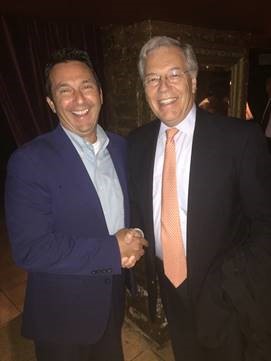
The Board’s Purpose Statement of “Bridging the Gap between Academia and the Financial Industry” seems like a model that works, as the industry evolves from the days of the trading pits and forward thinking firms and student adapt and seek out the new opportunities for knowledge and talent.
The McBride Trading involvement this year is of particular note, as they are committed to a multi-year trading partnership in which they intend to increase student career opportunities via the identification and vetting of potential hires through the RCM University Program.
Nothing will ever replace the raw energy and incredibly steep curve that was Chicago trading floors. But programs like this are a way to bridge the gap between those smart, hungry kids who may have found their way onto yesteryear’s floor and the modern computerized trading firms who may have been yesteryear’s mentors, financial backers, and teachers.
The only problem now…. Figuring out who we’re going to root for when Illinois plays Northwestern or ND plays UCLA.
For more on the RCM University Program, contact Joe Signorelli at 312-870-1547 or [email protected]