


Trading futures, forex, and other commodity interests involves substantial risk of loss and is not suitable for all investors. Past performance is not necessarily indicative of future results.
Diversification stands as one of investing’s most powerful concepts—yet many investors still misunderstand its true value. Beyond simply “not putting all your eggs in one basket,” proper diversification can create resilience against market volatility while potentially improving long-term returns. Let’s explore what diversification really means, why it matters, and how to implement it effectively.
What Is Diversification?
Diversification is the strategic allocation of investments across various asset classes to reduce overall portfolio risk while optimizing returns. Rather than concentrating wealth in a single investment type, diversified portfolios spread risk across multiple assets that respond differently to market conditions.
The concept is elegantly simple:
- There are dozens of asset classes available to investors
- Predicting which will perform best is virtually impossible
- Instead of betting everything on one asset, invest across many
- Winners offset losers, creating smoother long-term growth
Why Is Diversification Important in an Investment Portfolio?
Risk Reduction
The primary benefit of diversification is risk management. When one asset class underperforms, others may remain stable or even appreciate. This prevents catastrophic losses that can take years to recover from.
As illustrated in the Callan Periodic Table of Investment Returns, asset classes constantly rotate between top and bottom performers year after year. A diversified portfolio (represented by gray boxes) consistently maintains middle-ground performance—never experiencing the highest highs but crucially avoiding the devastating lows.
Smoother Recovery During Market Downturns
Research shows diversified portfolios recover from market corrections significantly faster than concentrated ones. Following the 2008 financial crisis, a portfolio with 30% in S&P 500, 30% in foreign stocks, and 40% in bonds regained its previous peak 14 months sooner than an all-stock portfolio (The Reformed Broker).
Even more impressive, portfolios containing 30% managed futures recovered 35 months earlier than stock-only portfolios during the same period, demonstrating the power of including truly uncorrelated assets.
Psychological Benefits
Perhaps diversification’s most underrated advantage is psychological. By reducing dramatic swings in portfolio value, diversification helps investors avoid panic-selling during market bottoms—one of the most destructive investor behaviors.
Diversification isn’t just about final returns but about “avoiding the swamps” along the investment journey. It provides the emotional stability to maintain long-term investment strategies even during market turbulence.
The Science Behind Diversification: Modern Portfolio Theory
Diversification isn’t merely conventional wisdom—it’s backed by Nobel Prize-winning research. Modern Portfolio Theory, developed by Harry Markowitz, demonstrates mathematically how combining uncorrelated assets can enhance returns while reducing risk.
The Efficient Frontier represents the optimal portfolio combinations that provide the highest expected return for a given level of risk. This concept introduced the revolutionary idea that portfolio components should be selected based on how they interact within the portfolio, not just their individual merits.
Types of Diversification Strategies
Asset Class Diversification
Asset Class Diversification is a vital strategy for creating a resilient investment portfolio by spreading investments across various asset classes, including stocks, bonds, real estate, commodities, and alternative investments.
Key Components of Asset Class Diversification
- Stocks: The cornerstone of most investor portfolios, this is usually the asset class investors are diversifying from…
- Bonds: Bonds typically offer steady income and tend to perform well during economic declines, making them essential for risk management.
- Real Estate: Investments in real estate can yield both income and appreciation, serving as a hedge against inflation and contributing to overall portfolio stability.
- Commodities: Commodities, such as gold and oil, act as hedges against inflation and currency fluctuations, further enhancing diversification.
- Alternative Investments: This category includes strategies such as hedge funds [link to hedge fund post], and includes non correlated Alts like managed futures and volatility strategies. .
Check out the Cockroach Approach whitepaper highlighting the importance of asset class diversification in managing risks and enhancing long-term wealth accumulation.
Time Diversification
Time diversification means spreading your investments across different dates rather than investing all at once, which helps reduce the random performance impacts that can occur from investing on any single date. One common way to do this is dollar-cost averaging to reduce timing risk. See Newfound Research’s piece on timing luck here: https://www.thinknewfound.com/rebalance-timing-luck
Strategy Diversification
Strategy diversification employs multiple investment approaches that respond differently to market conditions. This can involve combining systematic models with discretionary judgment, operating across multiple timeframes, and implementing complementary methodologies like trend-following, mean-reversion, relative value, and event-driven strategies. The proliferation of so called “Multi-Strat” hedge funds are built on this type of diversification.
Research shows portfolios diversified across investment strategies demonstrate greater resilience during market stress. During the 2020 pandemic crash, investors with exposure to both momentum and value strategies experienced less dramatic drawdowns than those committed exclusively to either approach (JPMorgan Chase).
(The following are often presented as “diversification,” but in reality, they only diversify within a single asset class, such as stocks or bonds. While this can be valuable on its own, it doesn’t achieve true diversification aimed at protecting against significant market sell-offs.)
Geographic Diversification
Note: This typically only diversifies your stock and/or bond holdings; during market-wide downturns, most sectors can fall together, leaving investors exposed to systematic market risk despite sector diversification.
Investing across different countries and regions to reduce exposure to any single economy.
Sector Diversification
Note: This typically only diversifies your stock and/or bond holdings; during market-wide downturns, most sectors can fall together, leaving investors exposed to systematic market risk despite sector diversification.
Allocating across various industries to mitigate sector-specific risks.
Investment Style Diversification
Note: This typically only diversifies your stock and/or bond holdings; during market-wide downturns, most sectors can fall together, leaving investors exposed to systematic market risk despite sector diversification.
Combining growth, value, income, and other investment approaches.
The Evolution of Diversification
Institutional portfolios have dramatically increased their diversification over recent decades, as evidenced by this graphic showing the Yale endowment’s investment exposures over the past 40 years:
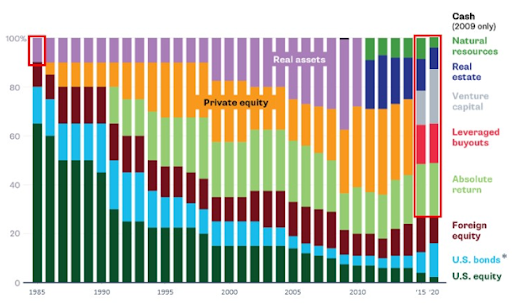
What began as simple stock/bond allocations has evolved into sophisticated multi-asset portfolios including:
- Stocks
- Bonds
- Real estate
- Commodities
- Private equity
- Venture capital
- Absolute Return providing Alternative investments
This shift reflects growing recognition that traditional 60/40 stock/bond portfolios no longer provide adequate diversification in today’s interconnected global markets.
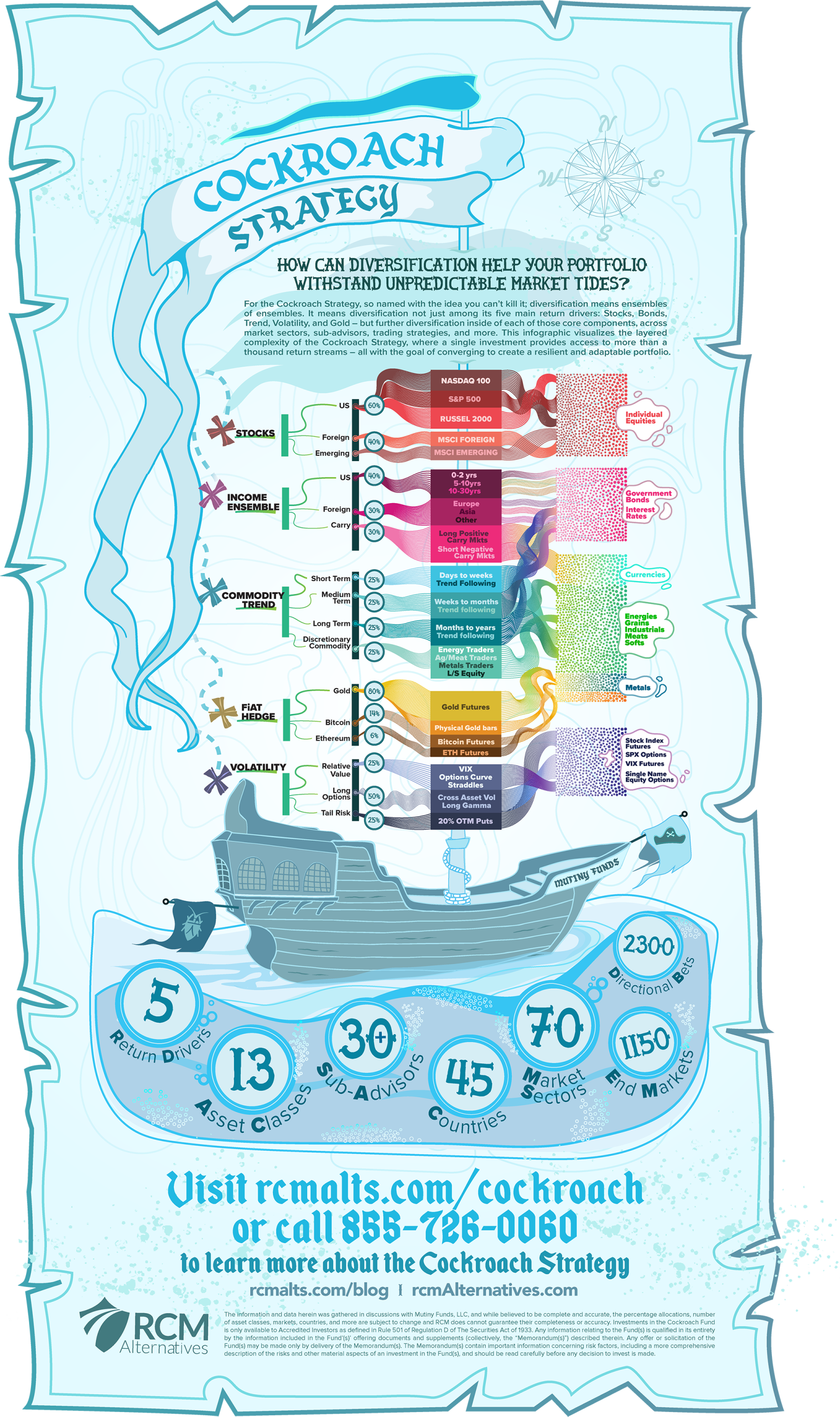
How’s all this look in practice – check out the following infographic highlighting one of the most diversified investment products we know of… the diversified Cockroach Strategy:
Get more information on the Cockroach Approach at Mutinyfund.com/cockroach