
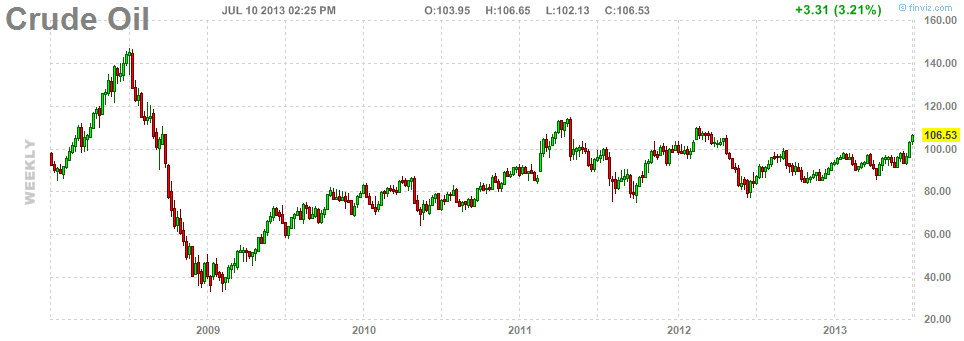
What do you get when you combine unrest in Egypt, an exploding train, and potential hurricane barreling down on the Gulf of Mexico? A $10+ rally in Crude Oil up to its highest levels since the spring of 2012, and really only its third major move above $100 a barrel since crashing from $150 down to $40 or so during the financial crisis in 2008. Crude is definitely on the move…
 There’s Egypt: We all remember the media exploding over the Wall Street Protests, but what about the single largest protest in human existence, resulting with the ousting of President Morsi, a new leader, and violent protests from the Muslim Brotherhood. 33 million people doing anything is enough to catch your attention – but 33 million people doing anything in the oil-rich Middle East definitely catches oil traders eyes.
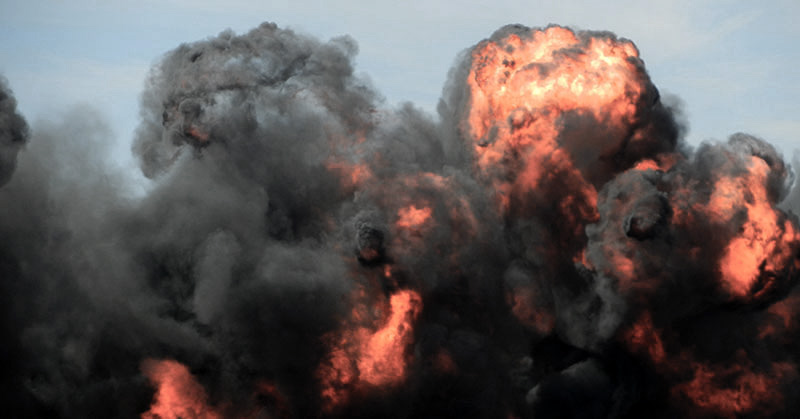
Now to Canada, where a horrific story in what seems to be the plot of thriller/suspense movie becomes reality. What do you get when 72 rail cars carrying 30,000 gallons of crude oil each derail then explode – an explosion several hundred feet high which flattened houses and killed many, with many still missing. We send out condolences to the people dealing with the aftermath, but we can’t help but think about how much oil that is. 72 cars x 30,000 gallons = 2.1 million Gallons of oil, or about 66,666 barrels of oil, or about 66 Oil futures contracts. The explosion didn’t have much of an impact on Oil futures (66 contracts isn’t enough to move the needle) but that’s a whole lot of money that just went up in smoke, 66,666 barrels * 103.02 futures price = $6.8 Million.
We finally arrive back in the U.S. with a pending hurricane – Ms. Chantal. We’ve talked about hurricane’s affect on managed futures before here. Luckily, Ms. Chantal is losing speed, but it’s expecting to make landfall on Florida’s east coast sometime this weekend. That should be good news for oil markets, as data shows the Gulf accounts for about 20% of all U.S. oil production and 6% of gas output. The Gulf also home to more than 40% of U.S. refining capacity. But wait, what if the oil industry could have up to the second updates on every single oil refinery in the Gulf Coast? Enter: The Department of Energy’s new tool:
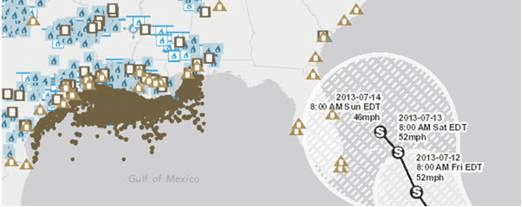
“It contains real-time information on tropical storms from the National Hurricane Center overlaid on a map of major U.S. energy infrastructure sites, including oil and gas rigs in the Gulf of Mexico, oil import sites, oil refineries, power plants and other facilities.”
Right now we imagine people heavily invested in the oil industry hitting the refresh button every minute. This may come to good use to get a feel for what could happen next as there’s already been three named hurricanes this season, which typically doesn’t occur until August.
But for all the headlines those three events have made – the real thing driving WTI oil prices may be more normal events here in the US. From RBN Energy:
“…two market events combined to create a sudden demand for supplies of light sweet crude such as Bakken from North Dakota and WTI from the Permian Basin at Midwest refineries. The first of these two events was the shutdown of a large production facility (known as an upgrader) in Western Canada that supplied up to 350 Mb/d of light sweet synthetic crude (syncrude) into the Midwest. The second event was the recent restart of the 250 Mb/d distillation unit at the BP Whiting, IL refinery after a shutdown and rebuild since last year. The BP rebuild will eventually allow the refinery to process heavy crude, but the new coker unit will take months to get ready for that task. In the meantime the refinery will process light sweet crude through the main distillation tower.”
In the end, most managed futures programs (we’re talking about the systematic, trend following types) don’t care why Crude is rallying, they just care if it is rallying. One notable exception to that would be fundamental energy trader Protec energy, who has been doing well in June and July, up an estimated 1.60% and 1.90% [past performance is not necessarily indicative of future results.]
But for the rest of the managed futures world, this move doesn’t mean much yet. If this is an uptrend in the making, it is still in its infancy – just now breaking out of its 18month range. To really make hay on this move, managed futures in general, and trend followers specifically, would likely need to see Crude break through the 2012 and 2011 highs and run to $120 or so. Here’s hoping! Although that would leave a mark at the gas pump to be sure.
Courtesy’s: Finviz.com
Egypt Photo Courtesy: The Atlantic Wire
Canada Train Photo Courtesy: ABC News
Department of Energy’s Tool Courtesy: WSJ


July 11, 2013
Great post blog writers. Love that intro.