
It makes us laugh to see people downplay the risks of investing in the futures markets. For one, they’re playing a dangerous game with the NFA, but in addition, they’re just wrong. Take for example this incredibly enlightening article on trading cocoa on the intellectual pedestal known as eHow (emphasis ours – and for our friends at the NFA, no, we don’t think this is good advice):
Cocoa is a commodity and as such it is traded in the commodity futures market. There are actually two ways to invest in cocoa, namely cocoa futures contracts and cocoa options. There are pros and cons to each method of investment, but overall it is relatively simple to invest in cocoa.
Good news, right? Don’t worry, it gets better:
1. Open a futures trading account. There are various brokers that specialize in futures and some that even allow you to trade stocks and futures. Some things to compare when evaluating brokers include commission costs, trading software and customer support services.
2. Deposit margin. Initial margin is the amount of money you need in your account to trade a particular futures contract and maintenance margin is the amount you must have to continue holding a position. The New York Mercantile Exchange (NYMEX) currently requires initial and maintenance margins of $3,300 and $3,000 respectively to trade one cocoa futures contract.
While the exchange sets the absolute minimums, your broker may have higher minimum margin requirements for clients. Also, bear in mind that there may be lower account requirements for trading cocoa options. Investors who want to invest in cocoa without risking too much money up front may want to start by investing in cocoa options.
3. Buy cocoa futures or call options. Each futures contract represents 10 tons of cocoa and the minimum price fluctuation or tick size is $1/ton or $10. This means that you gain $10 for every tick in your favor and lose $10 for every tick against your position. Profits and losses are credited or debited to all trading accounts at the end of each trading day.
Options work differently than futures contracts. With options, you pay a certain amount of money (referred to as the premium) to buy an option. The premium is the most you can lose on the trade. However, if the market moves in your favor, your option gains in value. At this point you can exercise the option and enter the cocoa futures market or simply sell the option for a profit.
That’s pretty adorable, if you ask us. It appears as though the author thinks that trading futures is so simple it can be done by a 7th grader who knows how to work a computer. Unfortunately, that little “how-to” leaves out some very important info – like the fact you could lose more than you deposit (especially if you’re only putting up the margin amounts). There’s a reason we say that futures trading is not suitable for everyone. To see why, take a look at the cocoa market this morning:
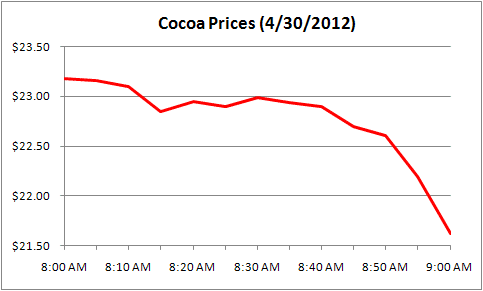
It’s moves like these, where the market falls 7% in an hour, that make us laugh at articles talking about how simple investing in commodities is. The fact of the matter is that it’s far more difficult than retail investing advocates will ever tell you, and the risks are substantial. That’s why we’re such strong advocates of managed futures. You get access to the commodity exposure that so many investors crave, but unlike investing in a long-only commodity ETF (which only gives you the chance to benefit when prices are going up), or attempting to trade on your own (which leaves you vulnerable to movements like today’s in cocoa), you get exposure through the systems and experience of professionals whose sole objective is to provide balanced exposure with an eye for risk management.
This doesn’t mean that working with a manager will prevent losses; some losses are inevitable. However, who would you rather hire to conduct an important brain surgery on your spouse: someone with slick marketing telling you how easy it is, or someone with years of experience and demonstrated results? For us, the answer is simple. We would rather have the expert with a track record.
But that’s just us.


April 8, 2015
help us for more information about trading cocoa
best regards