June 15, 2012
Attain Capital
Like
Every so often there’s a new study and accompanying article pointing out that actively managed mutual funds underperform their benchmarks. Frankly, nothing here is very surprising – it’s no great secret that mutual funds have been historically been beaten by their respective benchmark indices. This well-known dirty little secret is part of the reason ETFs have surged in popularity. Even alternative investment-based mutual funds appear to be suffering the same fate. Especially for cost-conscious registered investment advisers (RIAs), the lower cost of ETFs just makes sense. Why pay someone to make less money for you?
We work in a space where fees, from a surface level, can seem exorbitantly high to those unfamiliar with the space. Many an RIA has balked at the established 2 and 20 fee structure of the hedge fund and managed futures space during our conversations with them – the very same RIAs that have been part of this dash into ETFs. Now, we’ve defended this fee structure in the past, but with this most recent underperformance report, we found ourselves wondering what would happen if an RIA tried to apply passive index investing logic to the rest of the actively managed world – things like hedge funds and managed futures. What if you put together a portfolio tracking indices which follow roughly the same markets as an active hedge fund or CTA manager? Who would win? Is there a lower cost alternative to the 2 and 20 fee structure?
We took a simple approach, looking at a passive index of 33% bonds via the Citi World Bond Index, 33% stocks via the S&P 500, and 33% commodities via the Goldman Sachs Commodity Index for our “passive” portfolio. Real managers are likely nowhere near such splits, but like we said, it’s a very simplistic proxy. We then compared that to the Dow Jones Credit Suisse Hedge Fund Index and the BarclayHedge CTA Index.
If you take the completely irresponsible and shallow reporting angle and look at returns only, you see following (Disclaimer: past performance is not necessarily indicative of future results.)
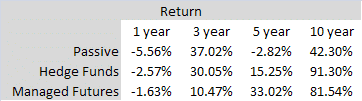
Not exactly a ringing endorsement for our passive portfolio, but looking at just returns is like considering a car based only on how fast it goes. You should probably also be concerned with whether brakes were installed or not, too. If we compare the passive versus active on a risk-adjusted basis, looking at both return over volatility ratios (Sharpe, using 0% as the risk free rate) and return over drawdown ratios (MAR), we see the active managers definitely outperforming over most of the time periods we examined:
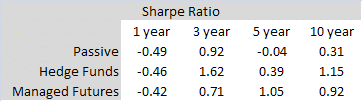
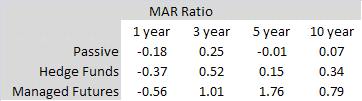
That’s right – managed futures on a 10 year lookback have roughly 3 times better returns per unit of volatility, and roughly 10 times better returns per unit of drawdown (worst peak to valley loss) than the passive index approach to performance replication (albeit an admittedly simplistic approach). Past performance is not necessarily indicative of future results, of course, but the historical performance makes a pretty clear distinction between the low cost ETF route and supposedly high cost hedge fund and managed futures strategies. You may be able to get better performance at a lower cost using ETFs instead of mutual funds (and we firmly believe you will if just trying to match a stock index), but if you want risk-adjusted performance, you’re going to have to bite the bullet and pay your 2 and 20. You get what you pay for, right?
Disclaimer
The performance data displayed herein is compiled from various sources, including BarclayHedge, and reports directly from the advisors. These performance figures should not be relied on independent of the individual advisor's disclosure document, which has important information regarding the method of calculation used, whether or not the performance includes proprietary results, and other important footnotes on the advisor's track record.
The programs listed here are a sub-set of the full list of programs able to be accessed by subscribing to the database and reflect programs we currently work with and/or are more familiar with.
Benchmark index performance is for the constituents of that index only, and does not represent the entire universe of possible investments within that asset class. And further, that there can be limitations and biases to indices such as survivorship, self reporting, and instant history. Individuals cannot invest in the index itself, and actual rates of return may be significantly different and more volatile than those of the index.
Managed futures accounts can subject to substantial charges for management and advisory fees. The numbers within this website include all such fees, but it may be necessary for those accounts that are subject to these charges to make substantial trading profits in the future to avoid depletion or exhaustion of their assets.
Investors interested in investing with a managed futures program (excepting those programs which are offered exclusively to qualified eligible persons as that term is defined by CFTC regulation 4.7) will be required to receive and sign off on a disclosure document in compliance with certain CFT rules The disclosure documents contains a complete description of the principal risk factors and each fee to be charged to your account by the CTA, as well as the composite performance of accounts under the CTA's management over at least the most recent five years. Investor interested in investing in any of the programs on this website are urged to carefully read these disclosure documents, including, but not limited to the performance information, before investing in any such programs.
Those investors who are qualified eligible persons as that term is defined by CFTC regulation 4.7 and interested in investing in a program exempt from having to provide a disclosure document and considered by the regulations to be sophisticated enough to understand the risks and be able to interpret the accuracy and completeness of any performance information on their own.
RCM receives a portion of the commodity brokerage commissions you pay in connection with your futures trading and/or a portion of the interest income (if any) earned on an account's assets. The listed manager may also pay RCM a portion of the fees they receive from accounts introduced to them by RCM.
Limitations on RCM Quintile + Star Rankings
The Quintile Rankings and RCM Star Rankings shown here are provided for informational purposes only. RCM does not guarantee the accuracy, timeliness or completeness of this information. The ranking methodology is proprietary and the results have not been audited or verified by an independent third party. Some CTAs may employ trading programs or strategies that are riskier than others. CTAs may manage customer accounts differently than their model results shown or make different trades in actual customer accounts versus their own accounts. Different CTAs are subject to different market conditions and risks that can significantly impact actual results. RCM and its affiliates receive compensation from some of the rated CTAs. Investors should perform their own due diligence before investing with any CTA. This ranking information should not be the sole basis for any investment decision.
See the full terms of use and risk disclaimer here.


Disclaimer
The performance data displayed herein is compiled from various sources, including BarclayHedge, and reports directly from the advisors. These performance figures should not be relied on independent of the individual advisor's disclosure document, which has important information regarding the method of calculation used, whether or not the performance includes proprietary results, and other important footnotes on the advisor's track record.
The programs listed here are a sub-set of the full list of programs able to be accessed by subscribing to the database and reflect programs we currently work with and/or are more familiar with.
Benchmark index performance is for the constituents of that index only, and does not represent the entire universe of possible investments within that asset class. And further, that there can be limitations and biases to indices such as survivorship, self reporting, and instant history. Individuals cannot invest in the index itself, and actual rates of return may be significantly different and more volatile than those of the index.
Managed futures accounts can subject to substantial charges for management and advisory fees. The numbers within this website include all such fees, but it may be necessary for those accounts that are subject to these charges to make substantial trading profits in the future to avoid depletion or exhaustion of their assets.
Investors interested in investing with a managed futures program (excepting those programs which are offered exclusively to qualified eligible persons as that term is defined by CFTC regulation 4.7) will be required to receive and sign off on a disclosure document in compliance with certain CFT rules The disclosure documents contains a complete description of the principal risk factors and each fee to be charged to your account by the CTA, as well as the composite performance of accounts under the CTA's management over at least the most recent five years. Investor interested in investing in any of the programs on this website are urged to carefully read these disclosure documents, including, but not limited to the performance information, before investing in any such programs.
Those investors who are qualified eligible persons as that term is defined by CFTC regulation 4.7 and interested in investing in a program exempt from having to provide a disclosure document and considered by the regulations to be sophisticated enough to understand the risks and be able to interpret the accuracy and completeness of any performance information on their own.
RCM receives a portion of the commodity brokerage commissions you pay in connection with your futures trading and/or a portion of the interest income (if any) earned on an account's assets. The listed manager may also pay RCM a portion of the fees they receive from accounts introduced to them by RCM.
Limitations on RCM Quintile + Star Rankings
The Quintile Rankings and RCM Star Rankings shown here are provided for informational purposes only. RCM does not guarantee the accuracy, timeliness or completeness of this information. The ranking methodology is proprietary and the results have not been audited or verified by an independent third party. Some CTAs may employ trading programs or strategies that are riskier than others. CTAs may manage customer accounts differently than their model results shown or make different trades in actual customer accounts versus their own accounts. Different CTAs are subject to different market conditions and risks that can significantly impact actual results. RCM and its affiliates receive compensation from some of the rated CTAs. Investors should perform their own due diligence before investing with any CTA. This ranking information should not be the sole basis for any investment decision.
See the full terms of use and risk disclaimer here.