
On the 11th anniversary of the terrorist attacks that rocked the nation, the country is in a state of reflection. The War on Terror continues, and enemies, new and old, still dot the horizon. But in an era of economic fragility, the new enemy, deserved or not, has become uncertainty. The fiscal cliff has been shoved to the peripheral as politics take center stage. No one ever expected the country’s fiscal issues to be addressed before November, but the debt rating agencies, this time around at least, don’t seem to be on board with the delay strategy. Bloomberg reports:
Moody’s Investors Service said it may join Standard & Poor’s in downgrading the U.S.’s credit rating unless Congress next year reduces the percentage of debt- to-gross-domestic-product during budget negotiations.
The U.S. economy will probably tip into recession next year if lawmakers and President Barack Obama can’t break an impasse over the federal budget and if George W. Bush-era tax cuts expire in what’s become known as the “fiscal cliff,” according to a report by the nonpartisan Congressional Budget Office published on Aug. 22. The rating would likely be cut to Aa1 from Aaa if an agreement on the debt ratio isn’t reached, Moody’s said in a statement today.
We’ve danced this dance before. Last August, the idea of the U.S. credit rating taking a hit was inconceivable. Visions of fiscal collapse dance through our heads, but before we succumb to recurring nightmares, let’s remind ourselves of what actually happened in the weeks and months following the last downgrade:
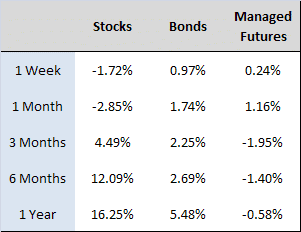
Stocks = S&P 500, Bonds = Vanguard Total Bond Market ETF (BND), Managed Futures = Newedge CTA Index
Doesn’t exactly paint the apocalyptic blowup that everyone anticipated. What was intended to reflect poorly on the creditworthiness never slowed down U.S. treasuries, and only dinged stocks momentarily. Why wasn’t there more backlash? Part of the reason was that even if our credit wasn’t great, it was still perceived as better than the other guy’s. It was also part of a TBTF economic perspective in the markets- the idea that the powers that be will never let things get that bad.
At the risk of sounding like one of those “this time is different” people, it does, in some ways, appear as though we’re getting to a turning point. The fiscal cliff is getting closer, and if the game of political chicken we saw last year gets a second take, and if there is not faith that the incoming Congress will be any different, we might be in trouble. Volume is already pretty low, with more investors disillusioned by the game. As one observer quipped on a Business Insider article last week, “The Herd of High Frequency Trading Bots are making peace with each other today because there’s not enough Muppets to rob.” If we can’t get our act in order, low volume paired with volatile circumstances could mean we’re in for trouble.
And what about those managed futures numbers? They aren’t particularly rosy. But why? Aren’t managed futures supposed to be intended for these types of volatile moments? As we discussed in our review of 2011, the difference is what followed the volatile moment. The markets didn’t respond with fear or elation; they responded with unease, facilitating choppy volatility and shorter trends that took a chunk out of managed futures performance. Some programs did well in the climate, especially agricultural programs, but it was not a climate that was beneficial for traditional longer-term trend followers.
So what next? It depends on whether the markets continue to drink the TBTF policy Koolaid, and for how long politicians continue to dole it out. With no firm action out of the Fed, and continued political uncertainty surrounding ECB plans, we aren’t confident the drinking supply will be sustained, but who knows? Stranger things have happened.


Disclaimer
The performance data displayed herein is compiled from various sources, including BarclayHedge, and reports directly from the advisors. These performance figures should not be relied on independent of the individual advisor's disclosure document, which has important information regarding the method of calculation used, whether or not the performance includes proprietary results, and other important footnotes on the advisor's track record.
The programs listed here are a sub-set of the full list of programs able to be accessed by subscribing to the database and reflect programs we currently work with and/or are more familiar with.
Benchmark index performance is for the constituents of that index only, and does not represent the entire universe of possible investments within that asset class. And further, that there can be limitations and biases to indices such as survivorship, self reporting, and instant history. Individuals cannot invest in the index itself, and actual rates of return may be significantly different and more volatile than those of the index.
Managed futures accounts can subject to substantial charges for management and advisory fees. The numbers within this website include all such fees, but it may be necessary for those accounts that are subject to these charges to make substantial trading profits in the future to avoid depletion or exhaustion of their assets.
Investors interested in investing with a managed futures program (excepting those programs which are offered exclusively to qualified eligible persons as that term is defined by CFTC regulation 4.7) will be required to receive and sign off on a disclosure document in compliance with certain CFT rules The disclosure documents contains a complete description of the principal risk factors and each fee to be charged to your account by the CTA, as well as the composite performance of accounts under the CTA's management over at least the most recent five years. Investor interested in investing in any of the programs on this website are urged to carefully read these disclosure documents, including, but not limited to the performance information, before investing in any such programs.
Those investors who are qualified eligible persons as that term is defined by CFTC regulation 4.7 and interested in investing in a program exempt from having to provide a disclosure document and considered by the regulations to be sophisticated enough to understand the risks and be able to interpret the accuracy and completeness of any performance information on their own.
RCM receives a portion of the commodity brokerage commissions you pay in connection with your futures trading and/or a portion of the interest income (if any) earned on an account's assets. The listed manager may also pay RCM a portion of the fees they receive from accounts introduced to them by RCM.
Limitations on RCM Quintile + Star Rankings
The Quintile Rankings and RCM Star Rankings shown here are provided for informational purposes only. RCM does not guarantee the accuracy, timeliness or completeness of this information. The ranking methodology is proprietary and the results have not been audited or verified by an independent third party. Some CTAs may employ trading programs or strategies that are riskier than others. CTAs may manage customer accounts differently than their model results shown or make different trades in actual customer accounts versus their own accounts. Different CTAs are subject to different market conditions and risks that can significantly impact actual results. RCM and its affiliates receive compensation from some of the rated CTAs. Investors should perform their own due diligence before investing with any CTA. This ranking information should not be the sole basis for any investment decision.
See the full terms of use and risk disclaimer here.