September 24, 2012
Attain Capital
Like
Our newsletter recently looked at how well stocks have bounced back since the lows of 2009, but another piece comparing stocks to gold during the recovery caught our eye. The argument is pretty simple: even with the incredible rally in the stock market, you would have been better off in gold. Via Alpha Now:
If you still find yourself struggling whether you’re more comfortable being “risk on” or “risk off” in the stock market these days, it might be time to consider something entirely different: the “Gold on” trade. “Gold on” – being long gold– has proven to be a strategy that has beaten the S&P 500 ever since the financial crisis began in 2007.
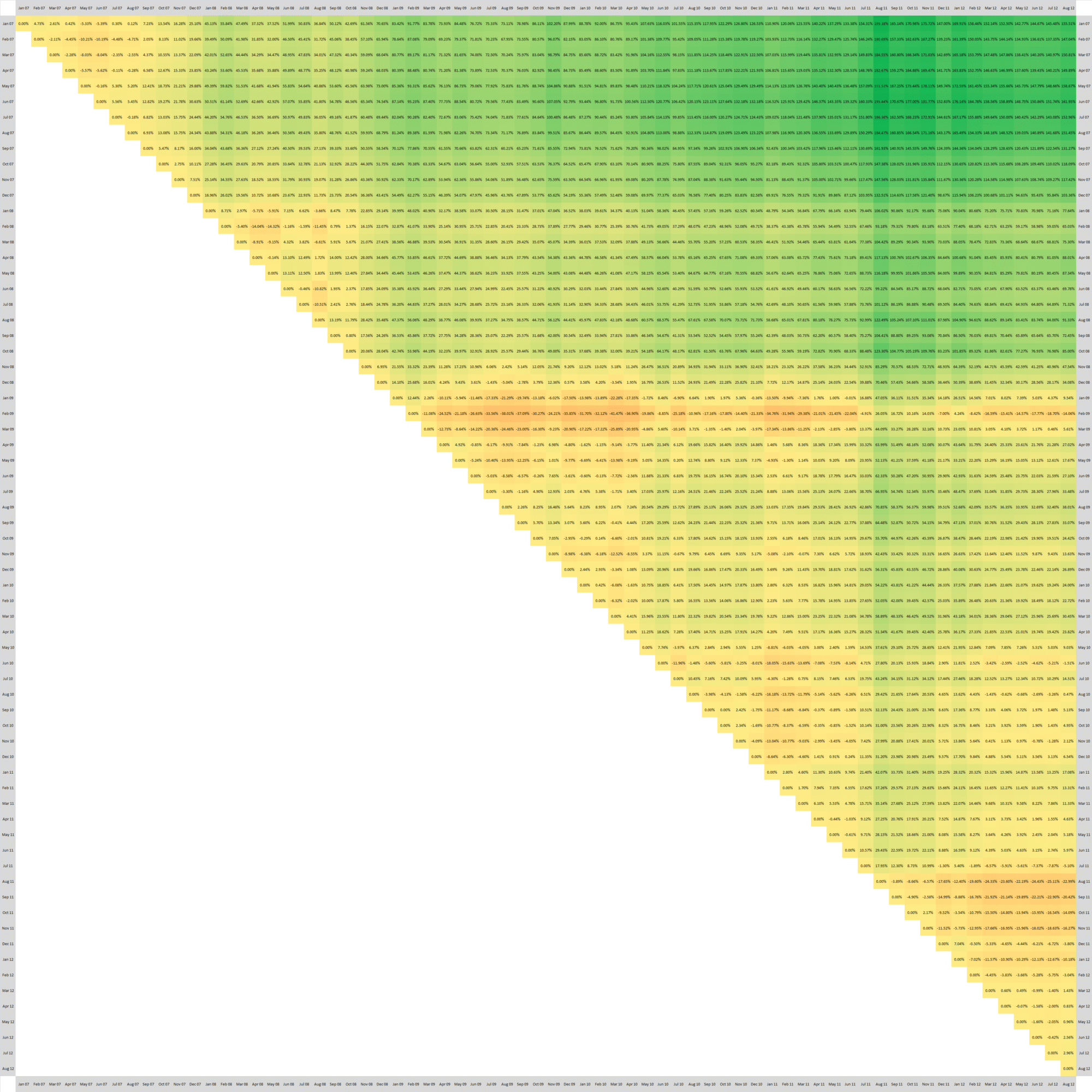
This got us thinking… picking a single point in time and calculating returns forward from there is nice, but it doesn’t show the whole picture. So, we put together a chart that shows the performance of the SPDR Gold Trust ETF versus the S&P 500 over every possible time period between January 2007 and August 2012 (on a monthly basis). The dates along the vertical axis represent the month you would have made your initial investment, while the dates along the horizontal axis represent the date you would have sold. Each cell shows how much better off you would have been (in percentage terms) if you had invested in GLD instead of the S&P 500. Each cell represents GLD performance minus the S&P 500 performance for the given time period. And what did we find?
Click for a gigantic version.
(Disclaimer: past performance is not necessarily indicative of future results.
The green regions show when you would have been better off with gold, while those splotches of orange represent time periods when you would have been better off in stocks. The yellow indicate periods when gold and stocks had similar performance. Gold has the clear advantage up until February 2009 – that conspicuous orange streak through the center of the chart. For the last two years, gold’s advantage has been generally negligible, and stocks have outperformed gold in 33% of the periods analyzed.
In the end, it’s not too surprising that gold has tended to outshine stocks – the last five years have been fairly exceptional for the yellow metal, and rather disappointing for the stock market. However, to say that one investment has beaten another for an entire time period is disingenuous at best – it depends on several factors, not the least of which is the timing of the investment. We often read such headlines – xyz investment beat out abc investment over the past 10 years – and intuitively think that means an investment in the former at any time over the past 10 years would have been better than the latter. But as we can see in the chart – that isn’t the case. Overall over-performance does not mean individual time period over-performance.
As the old saying goes – timing is everything.
Disclaimer
The performance data displayed herein is compiled from various sources, including BarclayHedge, and reports directly from the advisors. These performance figures should not be relied on independent of the individual advisor's disclosure document, which has important information regarding the method of calculation used, whether or not the performance includes proprietary results, and other important footnotes on the advisor's track record.
The programs listed here are a sub-set of the full list of programs able to be accessed by subscribing to the database and reflect programs we currently work with and/or are more familiar with.
Benchmark index performance is for the constituents of that index only, and does not represent the entire universe of possible investments within that asset class. And further, that there can be limitations and biases to indices such as survivorship, self reporting, and instant history. Individuals cannot invest in the index itself, and actual rates of return may be significantly different and more volatile than those of the index.
Managed futures accounts can subject to substantial charges for management and advisory fees. The numbers within this website include all such fees, but it may be necessary for those accounts that are subject to these charges to make substantial trading profits in the future to avoid depletion or exhaustion of their assets.
Investors interested in investing with a managed futures program (excepting those programs which are offered exclusively to qualified eligible persons as that term is defined by CFTC regulation 4.7) will be required to receive and sign off on a disclosure document in compliance with certain CFT rules The disclosure documents contains a complete description of the principal risk factors and each fee to be charged to your account by the CTA, as well as the composite performance of accounts under the CTA's management over at least the most recent five years. Investor interested in investing in any of the programs on this website are urged to carefully read these disclosure documents, including, but not limited to the performance information, before investing in any such programs.
Those investors who are qualified eligible persons as that term is defined by CFTC regulation 4.7 and interested in investing in a program exempt from having to provide a disclosure document and considered by the regulations to be sophisticated enough to understand the risks and be able to interpret the accuracy and completeness of any performance information on their own.
RCM receives a portion of the commodity brokerage commissions you pay in connection with your futures trading and/or a portion of the interest income (if any) earned on an account's assets. The listed manager may also pay RCM a portion of the fees they receive from accounts introduced to them by RCM.
Limitations on RCM Quintile + Star Rankings
The Quintile Rankings and RCM Star Rankings shown here are provided for informational purposes only. RCM does not guarantee the accuracy, timeliness or completeness of this information. The ranking methodology is proprietary and the results have not been audited or verified by an independent third party. Some CTAs may employ trading programs or strategies that are riskier than others. CTAs may manage customer accounts differently than their model results shown or make different trades in actual customer accounts versus their own accounts. Different CTAs are subject to different market conditions and risks that can significantly impact actual results. RCM and its affiliates receive compensation from some of the rated CTAs. Investors should perform their own due diligence before investing with any CTA. This ranking information should not be the sole basis for any investment decision.
See the full terms of use and risk disclaimer here.


November 6, 2012
US government has confiscated investors’ gold in the past. Today, there are different ways to invest in gold…