
March 6, 2012
Attain Capital
1 Like
It’s been over a year since we last dedicated a newsletter to the so-called managed futures mutual fund/ETF, and we thought it was high time we revisited the subject. Our last piece looked at the big name fund operators in the field– namely, the Wisdom Tree Managed Futures ETF (WDTI) and Rydex Managed Futures Fund (RYMFX)- arguing that these products were misnamed and did not give investors the type of managed futures exposure they were likely after when investing. While their performance then and to date has continued to be lackluster and well below managed futures as an asset class, it doesn’t seem to have hurt the popularity of the idea, with several smaller players now joining the fray to the tune of 19 such funds now clamoring after investor’s managed futures money. Hey, Morningstar even made them a fund category (anyone out there still arguing against their being an asset class?).
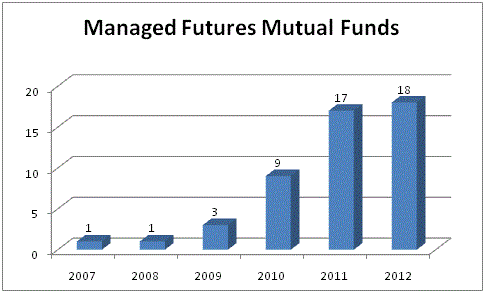
We found ourselves scratching our heads. Just why is so much money pouring into these so-called managed futures mutual funds when they have done very little in the way of performance? Part of the answer is the classic line from the brokerage side of Wall Street which says stocks (insert ETFs, mutual funds, mortgage backed securities, etc.) are sold, not bought- meaning that money is pouring into these products because that’s what the army of advisers (they don’t really call themselves stock brokers anymore) around the world are pitching to their clients, not the other way around.
But that begs the question… Why are these funds being sold so heartily? Part of that answer has to do with high fees for selling them, part of it is because people are still skeptical of stocks, and part of it is because managed futures is still a good story (boiled down in one line to – hey, it performed in 2008- even if past performance is not necessarily indicative of future results).
And that answer begs another question, do these advisors really know what they are selling (a recent blog posts says no) when it comes to managed futures exposure? Are the investors in so-called managed futures mutual funds really understanding what they are getting?
Well, we’re going to do our part to make sure those investors do know what they are getting, with an in-depth look at these products, and, unfortunately for the product managers, our research into the full universe of these publically traded products unearthed even more levels of complexity than we saw previously.

Click here to see the full piece.
Disclaimer
The performance data displayed herein is compiled from various sources, including BarclayHedge, and reports directly from the advisors. These performance figures should not be relied on independent of the individual advisor's disclosure document, which has important information regarding the method of calculation used, whether or not the performance includes proprietary results, and other important footnotes on the advisor's track record.
The programs listed here are a sub-set of the full list of programs able to be accessed by subscribing to the database and reflect programs we currently work with and/or are more familiar with.
Benchmark index performance is for the constituents of that index only, and does not represent the entire universe of possible investments within that asset class. And further, that there can be limitations and biases to indices such as survivorship, self reporting, and instant history. Individuals cannot invest in the index itself, and actual rates of return may be significantly different and more volatile than those of the index.
Managed futures accounts can subject to substantial charges for management and advisory fees. The numbers within this website include all such fees, but it may be necessary for those accounts that are subject to these charges to make substantial trading profits in the future to avoid depletion or exhaustion of their assets.
Investors interested in investing with a managed futures program (excepting those programs which are offered exclusively to qualified eligible persons as that term is defined by CFTC regulation 4.7) will be required to receive and sign off on a disclosure document in compliance with certain CFT rules The disclosure documents contains a complete description of the principal risk factors and each fee to be charged to your account by the CTA, as well as the composite performance of accounts under the CTA's management over at least the most recent five years. Investor interested in investing in any of the programs on this website are urged to carefully read these disclosure documents, including, but not limited to the performance information, before investing in any such programs.
Those investors who are qualified eligible persons as that term is defined by CFTC regulation 4.7 and interested in investing in a program exempt from having to provide a disclosure document and considered by the regulations to be sophisticated enough to understand the risks and be able to interpret the accuracy and completeness of any performance information on their own.
RCM receives a portion of the commodity brokerage commissions you pay in connection with your futures trading and/or a portion of the interest income (if any) earned on an account's assets. The listed manager may also pay RCM a portion of the fees they receive from accounts introduced to them by RCM.
Limitations on RCM Quintile + Star Rankings
The Quintile Rankings and RCM Star Rankings shown here are provided for informational purposes only. RCM does not guarantee the accuracy, timeliness or completeness of this information. The ranking methodology is proprietary and the results have not been audited or verified by an independent third party. Some CTAs may employ trading programs or strategies that are riskier than others. CTAs may manage customer accounts differently than their model results shown or make different trades in actual customer accounts versus their own accounts. Different CTAs are subject to different market conditions and risks that can significantly impact actual results. RCM and its affiliates receive compensation from some of the rated CTAs. Investors should perform their own due diligence before investing with any CTA. This ranking information should not be the sole basis for any investment decision.
See the full terms of use and risk disclaimer here.
March 15, 2012
[…] Managed Futures Mutual Funds Exposed (managed-futures-blog.attaincapital.com) […]
April 2, 2012
Thank you very much for this article. Very compelling as to why “managed futures mutual funds” are not a good investment.
BTW, I’m not sure if your question “anyone out there still arguing against their being an asset class?” was meant to be rhetorical, but apparently there is actually a very long list. Most relevant given you implied the “Morningstar Managed Futures Category” is proof of being an asset class is actually the anyone named John Rekenthaler, VP of Research at Morningstar. During a March 23, 2012 interview regarding alternative funds, John states, “We can start by differentiating between alternative strategies. So, an alternative strategy would be something like a long-short fund or maybe option writing strategies where you own securities and write options or manage futures. And then there is an alternative asset, say owning a commodity, owning oil futures or something like that.” You can listen to the entire interview at https://www.morningstar.com/Cover/videoCenter.aspx?id=538462.
Added to that list would be Morningstar researchers Samuel Lee and Nadia Papagiannis which repeatedly refer to managed futures as a “strategy” in their research paper, Managed Futures Category Handbook. You can find a copy here https://advisor.morningstar.com/uploaded/pdf/Alt_Managed-Category.pdf.
Perhaps Morningstar categories are based on something other than asset class distinction? By taking a quick glance at Morningstar’s Investing Glossary and reading their definition on “Morningstar Category”, we can see that the words “asset class” only appear one time. And that one time is to help describe the inner workings of the “Target-Date Portfolios” category, which I’m sure we all would agree is not an asset class, just like managed futures is not an asset class, at least according to Morningstar.
Thanks again for the great article.
April 5, 2012
Jason,
Thanks for commenting. Our justification for managed futures being an asset class is not derived from how it is referred to colloquially, but a breakdown of academic literature on the defining parameters of an asset class. We covered this last year, but you can view it here: https://www.attaincapital.com/alternative-investment-education/managed-futures-newsletter/investment-research-analysis/426/
And to be clear, it’s not that we think all managed futures mutual funds are evil incarnate. Some of these funds are false advertising at their best, but others are not all bad. Our issue is that it’s a largely inefficient way to gain access to an otherwise potentially beneficial asset class for the right investors.